• Home
  • Subjects
    • UPSC Commerce Optional
      • Syllabus – UPSC Commerce Optional
      • UPSC Commerce and Accountancy Optional Question Paper
      • Book
        • UPSC Commerce Optional Books – The Marathon of UPSC Commerce Optional
      • Blog
      • Courses
      • Answer Writing Practise
      • News
    • UGC NET – Commerce Optional
      • UGC NET – Syllabus
      • Past Papers
        • July 2018-Commerce
        • Dec 2017-Commerce
        • June 2017-Commerce
        • Dec 2016-Commerce
        • June 2016-Commerce
        • Dec 2015-Commerce
        • June 2015-Commerce
    • Chartered Accountant
      • Level-1 – Foundation
        • Syllabus
        • CA Level-1 Blog
      • Level-2 – Intermediate
        • Syllabus
        • CA Level-2 Blog
      • Level-3 – Final
        • Syllabus
        • CA Level-3 Blog
    • B.Com / M.Com
    • 11 Commerce
    • 12 Commerce
  • Blog
    • Income Tax
    • Economics
    • Accounts
    • Financial Management
    • HRM- Human Resource Management
    • Audit
    • Organization Behaviour
    • Industrial Relation (IR)
    • NCERT
      • 10th Class
      • 11th Class
      • 12th Class
      • 9th Class
  • Contact
    • Have any question?
    • +91 7905338496
    • achievercommerce@gmail.com
    Login
    Commerce Achiever
    • Home
    • Subjects
      • UPSC Commerce Optional
        • Syllabus – UPSC Commerce Optional
        • UPSC Commerce and Accountancy Optional Question Paper
        • Book
          • UPSC Commerce Optional Books – The Marathon of UPSC Commerce Optional
        • Blog
        • Courses
        • Answer Writing Practise
        • News
      • UGC NET – Commerce Optional
        • UGC NET – Syllabus
        • Past Papers
          • July 2018-Commerce
          • Dec 2017-Commerce
          • June 2017-Commerce
          • Dec 2016-Commerce
          • June 2016-Commerce
          • Dec 2015-Commerce
          • June 2015-Commerce
      • Chartered Accountant
        • Level-1 – Foundation
          • Syllabus
          • CA Level-1 Blog
        • Level-2 – Intermediate
          • Syllabus
          • CA Level-2 Blog
        • Level-3 – Final
          • Syllabus
          • CA Level-3 Blog
      • B.Com / M.Com
      • 11 Commerce
      • 12 Commerce
    • Blog
      • Income Tax
      • Economics
      • Accounts
      • Financial Management
      • HRM- Human Resource Management
      • Audit
      • Organization Behaviour
      • Industrial Relation (IR)
      • NCERT
        • 10th Class
        • 11th Class
        • 12th Class
        • 9th Class
    • Contact

      Accounts

      • Home
      • Blog
      • Learn - Free
      • Blogs
      • Accounts

      Obsolescence-Meaning,Definition,Examples,Technology-Driven Obsolescence,Market Driven Obsolescence,Guarding Your Business from Obsolescence,Accounting Treatment of Obsolete Items (Commerce Achiever)
      • Posted by commerce achiever1
      • Categories Accounts, Blogs, Learn - Free
      • Date April 13, 2021

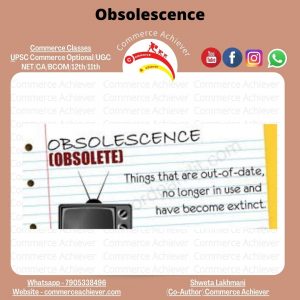
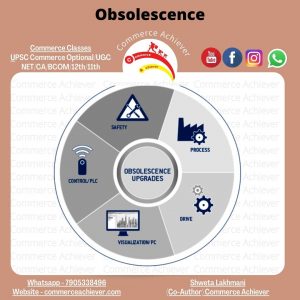
      Obsolescence is a notable reduction in the utility of an inventory item or fixed asset. The determination of obsolescence typically results in a write-down of the inventory item or asset to reflect its reduced value. Obsolescence can arise when there are less expensive alternatives in the marketplace, or when customer preferences change.

      Obsolescence differs from the ongoing decline in the value of assets that is caused by normal usage, resulting in wear and tear.

      Understanding Obsolescence
      Simply stated, inventory or any business asset becomes obsolete when the item is no longer salable or useful. This results in a loss of value to the business holding the item. For example, if your company purchased 100 widgets, sold 25 of them but could not sell the remaining 75 widgets, the remaining widgets would be considered obsolete inventory.

      Similarly, if a computer was purchased to run machinery in your factory but the machinery became incompatible with the computer after a required repair, the computer would be considered an obsolete asset if it could not be used elsewhere. That’s because it no longer has value to the business.

      Technology-Driven Obsolescence

      A key factor that causes obsolescence is a shift in technology or product design. When new components come to market, older parts become less useful and are usually designed out of a product or the manufacturing process.

      Likewise, rapidly changing technology in equipment also causes obsolescence. The push to make equipment better, cheaper and faster can render an asset obsolete in a short period of time – especially when trying to keep up with technology in a competitive marketplace.

      Market Driven Obsolescence

      Technology is not the only reason for obsolescence. Changes in customer preferences can greatly influence the salability of an item. This is common with fad toys where items can quickly go in or out of favor with children and their parents for any number of reasons. The bottom line is, if you can no longer sell the item, it’s considered obsolete inventory.

      Guarding Your Business from Obsolescence

      Since holding obsolete inventory or assets of any type can have a financial impact on your business, a prudent business owner should carefully examine their procurement practices. Although buying large lots of inventory may decrease the per-unit cost of the item, it can also put the business at risk if the items are not fully consumed or sold.

      In addition, business owners can safeguard capital assets from obsolescence by outfitting their businesses with leased equipment versus purchasing items outright. In this manner, the business is free to upgrade to new technology at the end of each lease or include a lease provision that allows for technology trades.

      Accounting Treatment of Obsolete Items

      No matter how an item becomes obsolete, there is accounting protocol for stating the impact on financial statements. First, inventory and assets should be periodically reviewed for obsolescence. Once identified as obsolete, items should be segregated on financial statements with a write-down by debiting an income-statement expense account and crediting a balance sheet contra-asset account such as inventory reserve.

      Second, the business can later attempt to return or sell the items at a reduced value. If successful, any monies realized from the effort can be used to offset the original reserve entry with a debit to the reserve contra-asset account and a credit to the expense account for the amount of the proceeds – reducing the stated loss to the company.

      Last, if the items are discarded because they have no value, the final entry would be a debit to clear the reserve contra-asset account and a credit to inventory when physically removed from the premises.

      Tag:Accounting Treatment of Obsolete Items, CAfoundation, CAfoundationaAccounts, CAfoundationClasses, CAfoundationEconomic, CAfoundationFees, CAfoundationLaw, CAfoundationRegistration, commerce, commerceachiever, CommerceAndAccountancy, CommerceBaba, Guarding Your Business from Obsolescence, Market Driven Obsolescence, Obsolescence, Technology-Driven Obsolescence

      • Share:
      commerce achiever1

      Previous post

      Net Realizable Value-Meaning,Definition,Examples of uses of Net Realizable Value (Commerce Achiever)
      April 13, 2021

      Next post

      Operating Profit-Meaning,Understanding,Examples,Formula,Benefits and Drawbacks of the Operating Profit Figure (Commerce Achiever)
      April 14, 2021

      You may also like

      functions & uses of Cost Accountant
      A medium size firm is making large profits and they do not have a Cost Accounting Department. There is a proposal to employ a Cost Accountant. What would you consider to be his functions and how can he make himself useful to the management
      June 16, 2023
      _Blog Post
      What are the functions of Cost Accounting?
      June 16, 2023
      UPSC Commerce and Accountancy Optional
      Commerce and Accountancy Optional Success Rate – UPSC Commerce & Accountancy Optional
      May 25, 2023
      • +91 7905338496
      • achievercommerce@gmail.com

      Our Subjects

      • UPSC Commerce Optional
      • UGC NET – Commerce Optional
      • Chartered Accountant
      • B.Com / M.Com
      • 11 Commerce
      • 12 Commerce

      Useful Links

      • Learn – Free
      • Income Tax
      • Economics
      • Accounts
      • Financial Management
      • HRM- Human Resource Management
      • Audit
      • Organization Behaviour
      • Industrial Relation (IR)
      • NCERT

      Subscribe

      Don’t lose out on any important Post and Update. Learn everyday with Experts!!

      Copyright © 2024-2025 Commerce Achiever | All Rights Reserved

      toto slot
      situs toto
      situs toto
      situs toto
      situs toto login
      toto slot
      toto slot
      idn slot
      slot hoki

      • Privacy
      • Terms
      • Sitemap
      • Purchase
      situs toto situs toto cerutu4d cerutu4d cerutu4d cerutu4d bo toto pulsa bo togel bo togel bo togel bo togel cerutu4d bandar toto macau bo toto situs togel situs togel cerutu4d cerutu4d cerutu4d cabe4d situs toto slot gacor situs togel situs toto agen toto situs togel situs toto situs togel resmi slot gacor slot gacor slot gacor
      situs toto situs toto cerutu4d cerutu4d cerutu4d cerutu4d bo toto pulsa bo togel bo togel bo togel bo togel cerutu4d bandar toto macau bo toto situs togel situs togel cerutu4d cerutu4d cerutu4d

      Login with your site account

      Lost your password?

      Message Us