• Home
  • Subjects
    • UPSC Commerce Optional
      • Syllabus – UPSC Commerce Optional
      • UPSC Commerce and Accountancy Optional Question Paper
      • Book
        • UPSC Commerce Optional Books – The Marathon of UPSC Commerce Optional
      • Blog
      • Courses
      • Answer Writing Practise
      • News
    • UGC NET – Commerce Optional
      • UGC NET – Syllabus
      • Past Papers
        • July 2018-Commerce
        • Dec 2017-Commerce
        • June 2017-Commerce
        • Dec 2016-Commerce
        • June 2016-Commerce
        • Dec 2015-Commerce
        • June 2015-Commerce
    • Chartered Accountant
      • Level-1 – Foundation
        • Syllabus
        • CA Level-1 Blog
      • Level-2 – Intermediate
        • Syllabus
        • CA Level-2 Blog
      • Level-3 – Final
        • Syllabus
        • CA Level-3 Blog
    • B.Com / M.Com
    • 11 Commerce
    • 12 Commerce
  • Blog
    • Income Tax
    • Economics
    • Accounts
    • Financial Management
    • HRM- Human Resource Management
    • Audit
    • Organization Behaviour
    • Industrial Relation (IR)
    • NCERT
      • 10th Class
      • 11th Class
      • 12th Class
      • 9th Class
  • Contact
    • Have any question?
    • +91 7905338496
    • achievercommerce@gmail.com
    Login
    Commerce Achiever
    • Home
    • Subjects
      • UPSC Commerce Optional
        • Syllabus – UPSC Commerce Optional
        • UPSC Commerce and Accountancy Optional Question Paper
        • Book
          • UPSC Commerce Optional Books – The Marathon of UPSC Commerce Optional
        • Blog
        • Courses
        • Answer Writing Practise
        • News
      • UGC NET – Commerce Optional
        • UGC NET – Syllabus
        • Past Papers
          • July 2018-Commerce
          • Dec 2017-Commerce
          • June 2017-Commerce
          • Dec 2016-Commerce
          • June 2016-Commerce
          • Dec 2015-Commerce
          • June 2015-Commerce
      • Chartered Accountant
        • Level-1 – Foundation
          • Syllabus
          • CA Level-1 Blog
        • Level-2 – Intermediate
          • Syllabus
          • CA Level-2 Blog
        • Level-3 – Final
          • Syllabus
          • CA Level-3 Blog
      • B.Com / M.Com
      • 11 Commerce
      • 12 Commerce
    • Blog
      • Income Tax
      • Economics
      • Accounts
      • Financial Management
      • HRM- Human Resource Management
      • Audit
      • Organization Behaviour
      • Industrial Relation (IR)
      • NCERT
        • 10th Class
        • 11th Class
        • 12th Class
        • 9th Class
    • Contact

      Accounts

      • Home
      • Blog
      • Learn - Free
      • Blogs
      • Accounts

      Revenue-Meaning,Understanding,Examples,Types,Accrued and Deferred revenue (Commerce Achiever)
      • Posted by commerce achiever1
      • Categories Accounts, Blogs, Learn - Free
      • Date April 21, 2021

      Revenue is the income generated from normal business operations and includes discounts and deductions for returned merchandise. It is the top line or gross income figure from which costs are subtracted to determine net income.

      ​Sales Revenue=Sales Price×Number of Units Sold​

      Revenue is also known as sales on the income statement. It is vital for a startup to get positive revenue early.

      KEY POINTS

      • Revenue, often referred to as sales, is the income received from normal business operations and other business activities.
      • Operating income is income derived from normal business operations, such as sales of goods or services.
      • Non-operating income is infrequent or nonrecurring income derived from secondary sources (e.g., lawsuit proceeds).

      Understanding Revenue
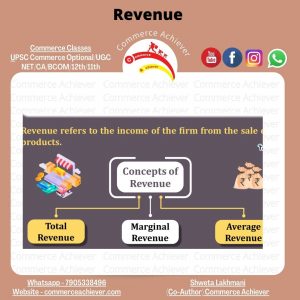
      Revenue is money brought into a company by its business activities. Revenue is also known as sales, as in the price-to-sales-ratio an alternative to the price-to-earnings-ratio that uses revenue in the denominator.

      There are different ways to calculate revenue, depending on the accounting method employed. Accrual accounting will include sales made on credit as revenue for goods or services delivered to the customer. It is necessary to check the cash flow statement to assess how efficiently a company collects money owed. Cash accounting, on the other hand, will only count sales as revenue when payment is received. Cash paid to a company is known as a “receipt”. It is possible to have receipts without revenue. For example, if the customer paid in advance for a service not yet rendered or undelivered goods, this activity leads to a receipt but not revenue.

      Revenue is known as the top line because it appears first on a company’s income statement. Net income, also known as the bottom line, is revenues minus expenses. There is a profit when revenues exceed expenses. To increase profit, and hence earnings per share for its shareholders, a company increases revenues and/or reduces expenses. Investors often consider a company’s revenue and net income separately to determine the health of a business. It is possible for net income to grow while revenues remain stagnant because of cost-cutting. Such a situation does not bode well for a company’s long-term growth. When public companies report their quaterly earnings, the two figures that receive the most attention are revenues and earnings per share (“earnings” being equivalent to net income). Subsequent price movement in stocks generally correlates to whether a company beat or missed analyst revenue and earnings per share expectations.

      Types of Revenue

      A company’s revenue may be subdivided according to the divisions that generate it. For example, a recreational vehicles department might have a financing division, which could be a separate source of revenue. Revenue can also be divided into operating revenue – sales from a company’s core business – and non-operating revenue which is derived from secondary sources. As these non-operating revenue sources are often unpredictable or nonrecurring, they can be referred to as one-time events or gains. For example, proceeds from the sale of an asset, a windfall from investments, or money awarded through litigation are non-operating revenue.

      Examples of Revenue

      In the case of government, revenue is the money received from taxation, fees, fines, inter-governmental grants or transfers, securities sales, mineral or resource rights, as well as any sales made.

      For non-profits, revenues are its gross receipts. Its components include donations from individuals, foundations, and companies; grants from government entities; investments; fundraising activities; and membership fees.

      In terms of real estate investments, revenue refers to the income generated by a property, such as rent, parking fees, on-site laundry costs, etc. When the operating expenses incurred in running the property are subtracted from property income, the resulting value is net operating income.

      Are revenue and cash flows the same thing?

      No. Revenue is the money a company earns from the sale of its products and services. Cash flow is the net amount of cash being transferred into and out of a company. Revenue provides a measure of the effectiveness of a company’s sales and marketing, whereas cash flow is more of a liquidity indicator.  Both revenue and cash flow should be analyzed together for a comprehensive review of a company’s financial health.

      How does one generate revenue?

      For many companies, revenues are generated from the sales of products or services. For this reason, revenue is sometimes known as gross sales.

      Revenue can also be earned via other sources. Inventors or entertainers may receive revenue from licensing, patents, or royalties. Real estate investors might earn revenue from rental income. Revenue for federal and local governments would likely be in the form of tax receipts from property or income taxes. Governments might also earn revenue from the sale of an asset or interest income from a bond. Charities and non-profit organizations usually receive income from donations and grants. Universities could earn revenue from charging tuition but also from investment gains on their endowment fund.

      What is accrued and deferred revenue?
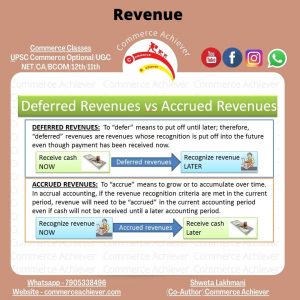
      Accrued revenue is the revenue earned by a company for the delivery of goods or services that have yet to be paid by the customer. In accrual accounting, revenue is reported at the time a sales transaction takes place and may not necessarily represent cash in hand. Deferred, or unearned revenue can be thought of as the opposite of accrued revenue, in that unearned revenue accounts for money prepaid by a customer for goods or services that have yet to be delivered. If a company has received prepayment for its goods, it would recognize the revenue as unearned, but would not recognize the revenue on its income statement until the period for which the goods or services were delivered.

      Can a company have positive revenue but negative profit?

      Yes. A company has a cost to produce goods sold, as well as other fixed costs and obligations like taxes and interest payments due on loans. As a result, if total costs exceed revenues, a company will have a negative profit even though it may be bringing in a lot of money from sales.

      Tag:accrued and deferred revenue, CAfoundation, CAfoundationaAccounts, CAfoundationClasses, CAfoundationEconomic, CAfoundationFees, CAfoundationLaw, CAfoundationRegistration, commerce, commerceachiever, CommerceAndAccountancy, CommerceBaba, revenue

      • Share:
      commerce achiever1

      Previous post

      Revenue-Meaning,Understanding,Types of Revenue,Examples of Revenue,Revenue and Cash flows,Accrued and Deferred revenue (Commerce Achiever)
      April 21, 2021

      Next post

      Revenue Reserve-Meaning,Understanding,Examples,Revenue Reserve Advantages,operating efficiency and revenue reserve (Commerce Achiever)
      April 22, 2021

      You may also like

      functions & uses of Cost Accountant
      A medium size firm is making large profits and they do not have a Cost Accounting Department. There is a proposal to employ a Cost Accountant. What would you consider to be his functions and how can he make himself useful to the management
      June 16, 2023
      _Blog Post
      What are the functions of Cost Accounting?
      June 16, 2023
      UPSC Commerce and Accountancy Optional
      Commerce and Accountancy Optional Success Rate – UPSC Commerce & Accountancy Optional
      May 25, 2023
      • +91 7905338496
      • achievercommerce@gmail.com

      Our Subjects

      • UPSC Commerce Optional
      • UGC NET – Commerce Optional
      • Chartered Accountant
      • B.Com / M.Com
      • 11 Commerce
      • 12 Commerce

      Useful Links

      • Learn – Free
      • Income Tax
      • Economics
      • Accounts
      • Financial Management
      • HRM- Human Resource Management
      • Audit
      • Organization Behaviour
      • Industrial Relation (IR)
      • NCERT

      Subscribe

      Don’t lose out on any important Post and Update. Learn everyday with Experts!!

      Copyright © 2024-2025 Commerce Achiever | All Rights Reserved

      toto slot
      situs toto
      situs toto
      situs toto
      situs toto login
      toto slot
      toto slot
      idn slot
      slot hoki

      • Privacy
      • Terms
      • Sitemap
      • Purchase
      situs toto situs toto cerutu4d cerutu4d cerutu4d cerutu4d bo toto pulsa bo togel bo togel bo togel bo togel cerutu4d bandar toto macau bo toto situs togel situs togel cerutu4d cerutu4d cerutu4d cabe4d situs toto slot gacor situs togel situs toto agen toto situs togel situs toto situs togel resmi slot gacor slot gacor slot gacor
      situs toto situs toto cerutu4d cerutu4d cerutu4d cerutu4d bo toto pulsa bo togel bo togel bo togel bo togel cerutu4d bandar toto macau bo toto situs togel situs togel cerutu4d cerutu4d cerutu4d

      Login with your site account

      Lost your password?

      Message Us