• Home
  • Subjects
    • UPSC Commerce Optional
      • Syllabus – UPSC Commerce Optional
      • UPSC Commerce and Accountancy Optional Question Paper
      • Book
        • UPSC Commerce Optional Books – The Marathon of UPSC Commerce Optional
      • Blog
      • Courses
      • Answer Writing Practise
      • News
    • UGC NET – Commerce Optional
      • UGC NET – Syllabus
      • Past Papers
        • July 2018-Commerce
        • Dec 2017-Commerce
        • June 2017-Commerce
        • Dec 2016-Commerce
        • June 2016-Commerce
        • Dec 2015-Commerce
        • June 2015-Commerce
    • Chartered Accountant
      • Level-1 – Foundation
        • Syllabus
        • CA Level-1 Blog
      • Level-2 – Intermediate
        • Syllabus
        • CA Level-2 Blog
      • Level-3 – Final
        • Syllabus
        • CA Level-3 Blog
    • B.Com / M.Com
    • 11 Commerce
    • 12 Commerce
  • Blog
    • Income Tax
    • Economics
    • Accounts
    • Financial Management
    • HRM- Human Resource Management
    • Audit
    • Organization Behaviour
    • Industrial Relation (IR)
    • NCERT
      • 10th Class
      • 11th Class
      • 12th Class
      • 9th Class
  • Contact
    • Have any question?
    • +91 7905338496
    • achievercommerce@gmail.com
    Login
    Commerce Achiever
    • Home
    • Subjects
      • UPSC Commerce Optional
        • Syllabus – UPSC Commerce Optional
        • UPSC Commerce and Accountancy Optional Question Paper
        • Book
          • UPSC Commerce Optional Books – The Marathon of UPSC Commerce Optional
        • Blog
        • Courses
        • Answer Writing Practise
        • News
      • UGC NET – Commerce Optional
        • UGC NET – Syllabus
        • Past Papers
          • July 2018-Commerce
          • Dec 2017-Commerce
          • June 2017-Commerce
          • Dec 2016-Commerce
          • June 2016-Commerce
          • Dec 2015-Commerce
          • June 2015-Commerce
      • Chartered Accountant
        • Level-1 – Foundation
          • Syllabus
          • CA Level-1 Blog
        • Level-2 – Intermediate
          • Syllabus
          • CA Level-2 Blog
        • Level-3 – Final
          • Syllabus
          • CA Level-3 Blog
      • B.Com / M.Com
      • 11 Commerce
      • 12 Commerce
    • Blog
      • Income Tax
      • Economics
      • Accounts
      • Financial Management
      • HRM- Human Resource Management
      • Audit
      • Organization Behaviour
      • Industrial Relation (IR)
      • NCERT
        • 10th Class
        • 11th Class
        • 12th Class
        • 9th Class
    • Contact

      Accounts

      • Home
      • Blog
      • Learn - Free
      • Blogs
      • Accounts

      Share Capital-Meaning,Understanding,Examples,Types-Authorized Share Capital,Issued Share Capital (Commerce Achiever)

      • Posted by commerce achiever1
      • Categories Accounts, Blogs, Learn - Free
      • Date April 23, 2021

      Share capital is the money a company raises by issuing common or preferred stock. The amount of share capital or equity financing a company has can change over time with additional Public offerings.

      The term share capital can mean slightly different things depending on the context. Accountants have a much narrower definition and their definition rules on the balance sheets of public companies. It means the total amount raised by the company in sales of shares.

      KEY POINTS

      • A company’s share capital is the money it raises from selling common or preferred stock.
      • Authorized share capital is the maximum amount a company has been approved to raise in a public offering.
      • A company may opt for a new offer of stock in order to increase the share capital on its balance sheet.

      Understanding Share Capital

      Share capital is reported by a company on its balance sheet in the shareholder’s equity section. The information may be listed in separate line items depending on the source of the funds. These usually include a line for common stock, another for preferred stock, and a third for additional paid-in-capital.

      Common stock and preferred stock shares are reported at their par value at the time of sale. In modern business, the “par” or face value is a nominal figure. The actual amount received by a company in excess of par value is reported as “additional paid-in capital.”

      On a balance sheet, the proceeds of stock sales are listed at their nominal par value while the “additional paid-in capital” line reflects the real price paid over par for the shares.

      The amount of share capital reported by a company includes only payments for purchases made directly from the company. The later sales and purchases of those shares and the rise or fall of their prices on the open market have no effect on the company’s share capital.

      A company may opt to have more than one public offering after its initial public offering(IPO). The proceeds of those later sales would increase the share capital on its balance sheet.

      Types of Share Capital
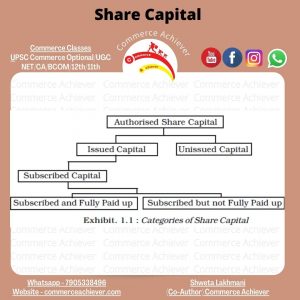
      The term “share capital” is often used to mean slightly different things depending on the context. When discussing the amount of money a company can legally raise through the sale of stock, there are several categories of share capital.

      Authorized Share Capital

      Before a company can raise equity capital, it must obtain permission to execute the sale of stock. The company must specify the total amount of equity it wants to raise and the base value of its shares, called the par value.

      The maximum amount of share capital a company is allowed to raise is called its authorized capital.

      This does not limit the number of shares a company may issue but it puts a ceiling on the total amount of money that can be raised by the sale of those shares. For example, if a company obtains authorization to raise $5 million and its stock has a par value of $1, it may issue and sell up to 5 million shares of stock.

      Issued Share Capital

      The total value of the shares a company elects to sell to investors is called its issued share capital. The par value of the issued share capital cannot exceed the value of the authorized share capital.

      Share Capital on a Balance Sheet

      The technical accounting definition of share capital is the par value of all equity securities, including common and preferred stock, sold to shareholders.

      However, people who are not accountants often include the price of the stock in excess of par value in the calculation of share capital. As noted, the par value of stock is nominal, typically $1 or less. So, the difference between the par value and the real sale price, called paid-in-capital, is usually considerable. Nevertheless, it is not technically included in share capital or capped by authorized capital limits.

      Here’s an example, and how it appears on a balance sheet: Assume company ABC issues 1,000 shares. Each share has a par value of $1 and sells for $25. The company’s accountant will record $1,000 as share capital and the remaining $24,000 as additional paid-in capital.

      Tag:Authorized Share Capital, CAfoundation, CAfoundationaAccounts, CAfoundationClasses, CAfoundationEconomic, CAfoundationFees, CAfoundationLaw, CAfoundationRegistration, commerce, commerceachiever, CommerceAndAccountancy, CommerceBaba, Issued Share Capital, Share capital

      • Share:
      commerce achiever1

      Previous post

      Secured Loan-Meaning,Advantages and Disadvantage of a Secured Loan,Examples,Features (Commerce Achiever)
      April 23, 2021

      Next post

      Shareholder Equity-Meaning,Understanding,Components of Shareholder Equity,Calculation (Commerce Achiever)
      April 23, 2021

      You may also like

      functions & uses of Cost Accountant
      A medium size firm is making large profits and they do not have a Cost Accounting Department. There is a proposal to employ a Cost Accountant. What would you consider to be his functions and how can he make himself useful to the management
      June 16, 2023
      _Blog Post
      What are the functions of Cost Accounting?
      June 16, 2023
      UPSC Commerce and Accountancy Optional
      Commerce and Accountancy Optional Success Rate – UPSC Commerce & Accountancy Optional
      May 25, 2023
      • +91 7905338496
      • achievercommerce@gmail.com

      Our Subjects

      • UPSC Commerce Optional
      • UGC NET – Commerce Optional
      • Chartered Accountant
      • B.Com / M.Com
      • 11 Commerce
      • 12 Commerce

      Useful Links

      • Learn – Free
      • Income Tax
      • Economics
      • Accounts
      • Financial Management
      • HRM- Human Resource Management
      • Audit
      • Organization Behaviour
      • Industrial Relation (IR)
      • NCERT

      Subscribe

      Don’t lose out on any important Post and Update. Learn everyday with Experts!!

      Copyright © 2024-2025 Commerce Achiever | All Rights Reserved

      toto slot
      situs toto
      situs toto
      situs toto
      situs toto login
      toto slot
      toto slot
      idn slot
      slot hoki

      • Privacy
      • Terms
      • Sitemap
      • Purchase
      situs toto situs toto cerutu4d cerutu4d cerutu4d cerutu4d bo toto pulsa bo togel bo togel bo togel bo togel cerutu4d bandar toto macau bo toto situs togel situs togel cerutu4d cerutu4d cerutu4d cabe4d situs toto slot gacor situs togel situs toto agen toto situs togel situs toto situs togel resmi slot gacor slot gacor slot gacor
      situs toto situs toto cerutu4d cerutu4d cerutu4d cerutu4d bo toto pulsa bo togel bo togel bo togel bo togel cerutu4d bandar toto macau bo toto situs togel situs togel cerutu4d cerutu4d cerutu4d

      Login with your site account

      Lost your password?

      Message Us