

Trade Discount-Meaning,Definition,Example,Formula (Commerce Achiever)
 Trade Discount
A trade discount is the amount by which a manufacturer reduces the retail price of a product when it sells to a reseller, rather than to the end customer. The reseller then charges the full retail price to its customers in order to earn a profit on the difference between the amount by which the manufacturer sold the product to it and the price at which it then sells the product to the final customer. The reseller does not necessarily resell at the suggested retail price; selling at a discount is a common practice, if the reseller wishes to gain market share or clear out excess inventory.
The trade discount may be stated as a specific dollar reduction from the retail price, or it may be a percentage discount. The trade discount customarily increases in size if the reseller purchases in larger quantities (such as a 20% discount if an order is 100 units or less, and a 30% discount for larger quantities). A trade discount may also be unusually large if the manufacturer is trying to establish a new distribution channel, or if a retailer has a great deal of distribution power, and so can demand the extra discount.
A manufacturer may attempt to establish its own distribution channel, such as a company website, so that it can avoid the trade discount and charge the full retail price directly to customers. This can cause disruption in the distributor network, and also may not increase company profits, since the company must now fulfill customer orders directly and provide customer service, as well as maintain the distribution channel.
The seller would not record a trade discount in its accounting records. Instead, it would only record revenue in the amount invoiced to the customer. If the seller were to record the retail price as well as a trade discount on an invoice to a reseller, this would create an unusually high gross sales amount in the income statement that might mislead any readers of the financial statements into thinking that the manufacturer has higher sales volume than is really the case (despite the presence of a large sales deduction for the trade discount).
Definition: A trade discount is the reduction in price a manufacturer or wholesaler gives a wholesaler or retail when they buy a product or group of products. In other words, a trade discount is a certain percentage a manufacturer is willing to reduce its list price for wholesalers or retailers.
What Does Trade Discount Mean?
Manufacturers and wholesalers typically produce catalogs for customers and vendors to order products from. The prices listed in the catalogs are often called list prices or manufacturers suggest retail price (MSRP). Other business within the industry that use the manufacturers products rarely pay list price for them. Instead, the manufacturer gives the wholesaler or retailer a discount on each purchase or a percent off of the list price.
A trade discount is different than a sales discount because a trade discount does not have the same restrictions as a purchase discount. Trade discounts are usually given to wholesalers that order large quantities of a product as well as retailers with good relationships with the manufacturer. Purchase discounts or cash discounts are based on payment plans not order quantities.
Example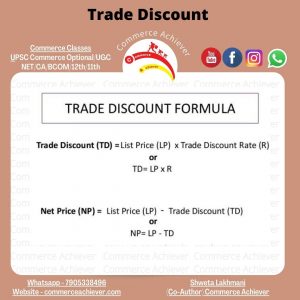
The amount of the trade discount varies depending on who is ordering the products and the quantities they are ordering. For instance, a retailer might only order 100 t-shirts from a manufacturer at a time and receive a 5 percent trade discount. A wholesaler, on the other hand, might order 1,000 t-shirts at a time and could receive a 12 percent discount. Trade discounts are also based on customer loyalty and vendor relationships over time.

You may also like


