• Home
  • Subjects
    • UPSC Commerce Optional
      • Syllabus – UPSC Commerce Optional
      • UPSC Commerce and Accountancy Optional Question Paper
      • Book
        • UPSC Commerce Optional Books – The Marathon of UPSC Commerce Optional
      • Blog
      • Courses
      • Answer Writing Practise
      • News
    • UGC NET – Commerce Optional
      • UGC NET – Syllabus
      • Past Papers
        • July 2018-Commerce
        • Dec 2017-Commerce
        • June 2017-Commerce
        • Dec 2016-Commerce
        • June 2016-Commerce
        • Dec 2015-Commerce
        • June 2015-Commerce
    • Chartered Accountant
      • Level-1 – Foundation
        • Syllabus
        • CA Level-1 Blog
      • Level-2 – Intermediate
        • Syllabus
        • CA Level-2 Blog
      • Level-3 – Final
        • Syllabus
        • CA Level-3 Blog
    • B.Com / M.Com
    • 11 Commerce
    • 12 Commerce
  • Blog
    • Income Tax
    • Economics
    • Accounts
    • Financial Management
    • HRM- Human Resource Management
    • Audit
    • Organization Behaviour
    • Industrial Relation (IR)
    • NCERT
      • 10th Class
      • 11th Class
      • 12th Class
      • 9th Class
  • Contact
    • Have any question?
    • +91 7905338496
    • achievercommerce@gmail.com
    Login
    Commerce Achiever
    • Home
    • Subjects
      • UPSC Commerce Optional
        • Syllabus – UPSC Commerce Optional
        • UPSC Commerce and Accountancy Optional Question Paper
        • Book
          • UPSC Commerce Optional Books – The Marathon of UPSC Commerce Optional
        • Blog
        • Courses
        • Answer Writing Practise
        • News
      • UGC NET – Commerce Optional
        • UGC NET – Syllabus
        • Past Papers
          • July 2018-Commerce
          • Dec 2017-Commerce
          • June 2017-Commerce
          • Dec 2016-Commerce
          • June 2016-Commerce
          • Dec 2015-Commerce
          • June 2015-Commerce
      • Chartered Accountant
        • Level-1 – Foundation
          • Syllabus
          • CA Level-1 Blog
        • Level-2 – Intermediate
          • Syllabus
          • CA Level-2 Blog
        • Level-3 – Final
          • Syllabus
          • CA Level-3 Blog
      • B.Com / M.Com
      • 11 Commerce
      • 12 Commerce
    • Blog
      • Income Tax
      • Economics
      • Accounts
      • Financial Management
      • HRM- Human Resource Management
      • Audit
      • Organization Behaviour
      • Industrial Relation (IR)
      • NCERT
        • 10th Class
        • 11th Class
        • 12th Class
        • 9th Class
    • Contact

      Accounts

      • Home
      • Blog
      • Learn - Free
      • Blogs
      • Accounts

      Book value-Meaning,Mark to Market Valuation,Price-to-Book Ratio (Commerce Achiever)

      • Posted by commerce achiever1
      • Categories Accounts, Blogs, Learn - Free
      • Date March 13, 2021

      Book value is equal to the cost of carrying an asset on a company’s balance sheet, and firms calculate it netting the asset against its accumulated depreciation. As a result, book value can also be thought of as the net asset value (NAV) of a company, calculated as its total assets minus intangible assets (patents, goodwill) and liabilities. For the initial outlay of an investment, book value may be net or gross of expenses such as trading costs, sales taxes, service charges, and so on.

      The formula for calculating book value per share is the total common stockholders’ equity less the preferred stock, divided by the number of common shares of the company. Book value may also be known as “net book value” and, in the U.K., “net asset value of a firm.”

      KEY POINTS
      • The book value of a company is the net difference between that company’s total assets and total liabilities, where book value reflects the total value of a company’s assets that shareholders of that company would receive if the company were to be liquidated.
      • An asset’s book value is equivalent to its carrying value on the balance sheet.
      • Book value is often lower than a company’s or asset’s market value.
      • Book value per share (BVPS) and the price-to-book (P/B) ratio are utilize book value in fundamental analysis.

      Understanding Book Value

      Book value is the accounting value of the company’s assets less all claims senior to common equity (such as the company’s liabilities). The term book value derives from the accounting practice of recording asset value at the original historical cost in the books.

      While the book value of an asset may stay the same over time by accounting measurements, the book value of a company collectively can grow from the accumulation of earnings generated through asset use. Since a company’s book value represents the shareholding worth, comparing book value with the market value of the shares can serve as an effective valuation technique when trying to decide whether shares are fairly priced.As the accounting value of a firm, book value has two main uses:

      1. It serves as the total value of the company’s assets that shareholders would theoretically receive if a company was liquidated.
      2. When compared to the company’s market value, book value can indicate whether a stock is under- or overpriced.

      Book value per share (BVPS) is a method to calculate the per-share book value of a company based on common shareholders’ equity in the company. Should the company dissolve, the book value per common share indicates the dollar value remaining for common shareholders after all assets are liquidated and all debtors are paid. If a company’s BVPS is higher than its market value per share, then its stock may be considered to be undervalued.

      In personal finance, the book value of an investment is the price paid for a security or debt investment. When a company sells stock, the selling price minus the book value is the capital gain or loss from the investment.

      Mark to Market Valuation

      There are limitations to how accurately book value can be a proxy to the shares’ market worth when mark to market valuation is not applied to assets that may experience increases or decreases of their market values.

      For example, real estate owned by a company may gain in market value at times, while its old machinery can lose value in the market because of technological advancements. In these instances, book value at the historical cost would distort an asset or a company’s true value, given its fair market price.

      Price-to-Book Ratio
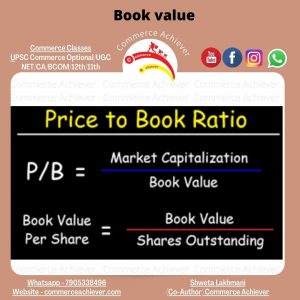
      Price -to-Book (P/B) ratio  as a valuation multiple is useful for value comparison between similar companies within the same industry when they follow a uniform accounting method for asset valuation. The ratio may not serve as a valid valuation basis when comparing companies from different sectors and industries whereby some companies may record their assets at historical costs and others mark their assets to market.

      As a result, a high P/B ratio would not necessarily be a premium valuation, and conversely, a low P/B ratio would not automatically be a discount valuation.

      Tag:Book value, CAfoundation, CAfoundationaAccounts, CAfoundationClasses, CAfoundationEconomic, CAfoundationFees, CAfoundationLaw, CAfoundationRegistration, commerce, commerceachiever, CommerceAndAccountancy, CommerceBaba, Mark to Market Valuation, Price-to-Book Ratio

      • Share:
      commerce achiever1

      Previous post

      Bonus shares-Definition,Process,Tax Implications (Commerce Achiever)
      March 13, 2021

      Next post

      Debenture-Meaning,Type,Features (Commerce Achiever)
      March 13, 2021

      You may also like

      functions & uses of Cost Accountant
      A medium size firm is making large profits and they do not have a Cost Accounting Department. There is a proposal to employ a Cost Accountant. What would you consider to be his functions and how can he make himself useful to the management
      June 16, 2023
      _Blog Post
      What are the functions of Cost Accounting?
      June 16, 2023
      UPSC Commerce and Accountancy Optional
      Commerce and Accountancy Optional Success Rate – UPSC Commerce & Accountancy Optional
      May 25, 2023
      • +91 7905338496
      • achievercommerce@gmail.com

      Our Subjects

      • UPSC Commerce Optional
      • UGC NET – Commerce Optional
      • Chartered Accountant
      • B.Com / M.Com
      • 11 Commerce
      • 12 Commerce

      Useful Links

      • Learn – Free
      • Income Tax
      • Economics
      • Accounts
      • Financial Management
      • HRM- Human Resource Management
      • Audit
      • Organization Behaviour
      • Industrial Relation (IR)
      • NCERT

      Subscribe

      Don’t lose out on any important Post and Update. Learn everyday with Experts!!

      Copyright © 2024-2025 Commerce Achiever | All Rights Reserved

      toto slot
      situs toto
      situs toto
      situs toto
      situs toto login
      toto slot
      toto slot
      idn slot
      slot hoki

      • Privacy
      • Terms
      • Sitemap
      • Purchase
      situs toto situs toto cerutu4d cerutu4d cerutu4d cerutu4d bo toto pulsa bo togel bo togel bo togel bo togel cerutu4d bandar toto macau bo toto situs togel situs togel cerutu4d cerutu4d cerutu4d cabe4d situs toto slot gacor situs togel situs toto agen toto situs togel situs toto situs togel resmi slot gacor slot gacor slot gacor
      situs toto situs toto cerutu4d cerutu4d cerutu4d cerutu4d bo toto pulsa bo togel bo togel bo togel bo togel cerutu4d bandar toto macau bo toto situs togel situs togel cerutu4d cerutu4d cerutu4d

      Login with your site account

      Lost your password?

      Message Us