

Capital Receipts and Revenue Receipts-Meaning,Definition,Difference,Examples,Infographics (Commerce Achiever)
The primary difference between Capital Receipts vs Revenue Receipts is that Capital receipts are the receipts of non-recurring nature which either creates the liability of the company or reduces the company’s assets whereas revenue receipts are the receipts of recurring nature and are reported in the statement of income of the company.
Differences Between Capital Receipts and Revenue Receipts
Receipts are just the opposites of expenses. But without receipts, there may be no existence of the business. Not all receipts directly increase the profits or decrease the loss. But some affect the profit or loss directly.
In this article, we will be talking about capital receipts and revenue receipts. In simple terms, capital receipts don’t affect the profit or loss of the business; for example, we can say that the sale of long-term assets is one sort of capital receipts.
But revenue receipts affect the profit or loss of a company. As an example, we can say that the sale of products, the commission received, etc. are revenue receipts.

The nature and function of capital receipts and revenue receipts are completely different. In this article, we will do a comparative analysis of capital receipts vs. revenue receipts.
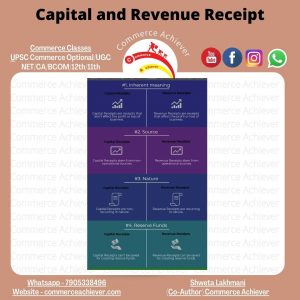
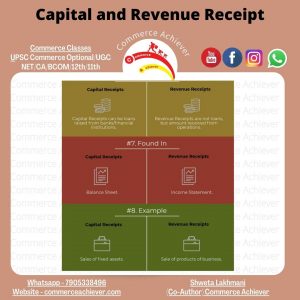
Capital Receipts vs. Revenue Receipts Infographics
There are many differences between capital receipts vs. revenue receipts. Let’s have a look.
What are Capital Receipts?
Capital receipts are those receipts which either create liability or reduce an asset. Capital Receipts, as mentioned above, are non-recurring in nature. And these sorts of receipts are also not received every now and then.
From the above definition, it’s clear that a receipt can be called capital receipt if it adheres to at least one of the following conditions –
- It must create a liability. For example, if a company takes a loan from a bank or a financial institution, then it would create a liability. That’s why it is a capital receipt in nature. But if a company received a commission for using its expertise in producing a special type of product for another company, it would not be called a capital receipt because it didn’t create any liability.
- It must reduce the assets of the company. For example, if a company sells out its shares to the public, it would help reduce the asset, which could create more money in the future. That means it should be treated as a capital receipt.
Types of Capital Receipts
Capital Receipts can be classified into three types.
-
Borrowing funds
When a company takes loans from banks or financial institutions, then it would be called borrowing funds. Borrowing funds from a financial institution is one of three forms of capital receipts.
-
Recovery of loans
To recover loans, often, the company needs to set aside one part of assets, which reduces the value of assets. This is the second type of capital receipts.
-
Other Capital Receipts
There’s a third type of receipts that we call “other capital receipts.” Under this, we include disinvestment and small savings. Disinvestment means selling off one part of the business. Disinvestment is called capital receipt because it reduced the asset of the company. Small savings are called capital receipts because they create a liability for the business.
Examples of Capital Receipts
Let’s now look at six examples of capital receipts. We will explain each of them and find out why they can be called capital receipts.
Capital Receipts Example: 1 – The money received from the shareholders
When a company needs more money, it can go for initial public offerings (IPOs). IPO helps a company to become public. When a firm gets public, then they sell their shares to the public. People who own the shares of the company are called shareholders of the company. Shareholders of the company hold shares of the company in lieu of offering money to the company. That means when a person purchases a share, he gives away the price of the share to the company. Through IPOs, the company earns a lot of money. And this money received from the shareholders can be called capital receipts because –
- The money received from the shareholders creates a liability for the company.
- The money received from the shareholders is non-recurring in nature.
- The money received from the shareholders is also non-routine, meaning it doesn’t happen every now and then.
Capital Receipts Example: 2 – The money received from the debenture holders
When the company needs a lot of money, they go to people with bonds. The company issue bonds, and the debenture holders buy the bonds in lieu of money. The company promises the debenture holders that it will pay off the debt and a high interest within a certain period of time. These bonds are not backed by any collateral and especially dependent on the credit worthiness of the issuer. That’s why the interest rate is quite high. The money received from the debenture holders is capital receipt because –
- The money received from the debenture holders creates a liability for the company.
- The money received from the debenture holders is non-recurring in nature.
- The money received from the debenture holders is also non-routine, meaning it doesn’t happen every now and then.
Capital Receipts Example: 3 – Loans taken from banks or financial institutions
Often business needs to invest money to support any new project or partnership or expansion. But business always doesn’t have the money to invest. That’s why they go out to a bank or any financial institution to raise loans. These loans can be either secured loans or unsecured loans. The money received from these loans is then used for investing in the new project or for expanding their business. These loans taken from banks or financial institutions are capital receipts because –
- These loans create liability for the company.
- These loans are non-recurring in nature.
- These loans are not taken every now and then.
Capital Receipts Example: 4 – Sale of Investments
Let’s say that a company has invested some money into an investment fund. Now the company needs to influx some cash into the business. That’s why it decides to sell the investments to a buyer. Selling off the investments will help the company get some immediate money. And we will call it a capital receipt for the following reasons –
- Sale of investments reduces the assets of the company.
- Sale of investments is non-recurring in nature.
- Sale of investments is also non-routine.
Capital Receipts Example: 5 – Sale of Equipment
If a company sells out one of its equipment to get cash, it would be a capital receipt too. Here are the reasons why this is also a capital receipt –
- Sale of equipment decreases the value of assets of the company.
- Sale of equipment is non-recurring in nature.
- Sale of equipment is non-routine as well.
Capital Receipts Example: 6 – Insurance claim for damaged plant & machinery
Insurance can be claimed when the plant & machinery loses its value. And we can call it capital receipt as well because of the following reasons –
- Insurance claim means a reduction of assets of the company.
- Insurance claim doesn’t occur every day.
- Insurance claim is also not routine.
What are Revenue Receipts?
Revenue Receipts are those receipts that neither reduce the assets of the company, nor they create any liability. They are always recurring in nature, and they are earned during the normal course of business.
From the definition, it is clear that any type of receipt needs to satisfy one of the two conditions to be called as revenue receipt –
- First, it must not reduce the assets of the company.
- Second, it must not create any liability for the company.
Features of Revenue Receipts
Since revenue receipts seem to be the opposite of capital receipts, it makes perfect sense to look at different features of revenue receipts so that we can understand the meaning of revenue receipts and can compare to the features of capital receipts.
Let’s have a look –
- Means for survival: A business starts its operations because it expects to receive money as a result of their service to their customers. Either they can sell a bunch of products, or they can offer services. No matter what they do, without revenue receipts, they can’t survive for long because revenue receipts are collected from the direct operations of the business.
- Applicable for a short term: Revenue receipts are money received for a short period. The benefit of revenue receipts can only be enjoyed for one accounting year and not more.
- Recurring: Since revenue receipts offer benefits for a short period, the revenue receipts must be recurring. If revenue receipts don’t recur, the business wouldn’t be able to perpetuate for long.
- Affects the profit/loss: Receiving revenue directly affects the profit/loss of the business. When the revenue is received, either profit is increased, or loss is decreased.
- A small amount (volume): Compared to capital receipts, the number of revenue receipts is usually smaller. That doesn’t mean all revenue receipts are smaller. For example, if a company sells 1 million products in a given year, the revenue receipts could be huge and could also be more than its capital receipts during the year.
Examples of Revenue Receipts
In this section, we will look at six examples of revenue receipts. At the end of each example, we will investigate why this particular receipt can be called revenue receipt.
Revenue Receipts Example: 1 – Revenue earned by selling off waste/scrap material
When a firm doesn’t use the waste material or scram items, they decide to sell it off. By selling scrap items, the business earns a good amount of money. We will call it a revenue receipt. We will call it revenue receipt because of the following reasons –
- Selling off scraps doesn’t reduce the assets of the company.
- Selling off scraps doesn’t create any liability for the company.
Revenue Receipts Example: 2 – Discount received from vendors
When a firm purchases raw materials, they select vendors from whom they buy the ingredients. Often when the firm pays on time or early, vendors offer a discount. This discount received from vendors would be revenue receipt because –
- Discount received from vendors doesn’t reduce the assets of the company.
- Discount received from vendors doesn’t create any liability for the company.
Revenue Receipts Example: 3 – Services provided
When a firm provides services to its clients or customers, they earn revenues. We will call them revenue receipts since –
- Services provided to clients don’t reduce the assets of the company.
- Services provided to clients don’t create any liability.
- And it is recurring in nature.
Revenue Receipts Example: 4 – Interest received
If a firm has put its money in any bank or financial institution, it will receive interest as its reward. It is a revenue receipt because –
- It doesn’t create any liability of the company.
- It also doesn’t reduce the assets of the company.
Revenue Receipts Example: 5 – Rent received
If a firm offers their place to another company, they can collect rent, and it would be considered as revenue receipt for the following reasons –
- Rent would be received every month; that means it is recurring in nature.
- Rent received wouldn’t create any liability for the company.
- It would also not reduce the assets of the company.
Revenue Receipts Example: 6 – Dividend received
If the company has purchased shares for any other company, at the end of the year, if profit is made, the firm would receive the dividend. This dividend received would be revenue receipts since
- It doesn’t reduce the assets of the company.
- And it also doesn’t create any liability for the company.
Also, have a look at Dividend Payout Calculations.
Capital Receipts vs. Revenue Receipts – Key differences
There are many differences between capital receipts vs. revenue receipts. Let’s look at the most prominent ones –
- Capital receipts are non-recurring in nature; on the other hand, revenue receipts are recurring in nature.
- Without capital receipts, a business can survive, but without revenue receipts, there is no chance that a business will perpetuate.
- Capital receipts can’t be used as a distribution of profits; revenue receipts can be distributed after deducting the expenses incurred to earn the revenue.
- Capital receipts can be found in the balance sheet. Revenue receipts can be found in the income statement.
- Capital receipts either reduce the assets of the company or create liability for the company. Revenue receipts are the opposite. They neither create the liability for the company, nor do they reduce the assets of the company.
- Capital receipts are non-routine. Revenue receipts are routine.
- Capital receipts are sources from non-operational sources. On the other hand, revenue receipts are sourced from operational sources.
Capital Receipts vs. Revenue Receipts (Comparison Table)
| Basis for Comparison – Capital Receipts vs. Revenue Receipts | Capital Receipts | Revenue Receipts |
| 1. Inherent meaning | Capital Receipts are receipts that don’t affect the profit or loss of business. | Revenue Receipts are receipts that affect the profit or loss of business. |
| 2. Source | Capital Receipts stem from non-operational sources. | Revenue Receipts stem from operational sources. |
| 3. Nature | Capital Receipts are non-recurring. | Revenue Receipts are recurring in nature. |
| 4. Reserve funds | Capital Receipts can’t be saved for creating reserve funds. | Revenue Receipts can be saved for creating reserve funds. |
| 5. Distribution | Not available for distribution of profits. | Available for distribution of profits. |
| 6. Loans – Capital Receipts vs. Revenue Receipts | Capital Receipts can be loans raised from banks/financial institutions. | Revenue Receipts are not loans, but the amount received from operations. |
| 7. Found in | Balance Sheet | Income Statement. |
| 8. Example – Capital Receipts vs. Revenue Receipts | Sales of fixed assets. | Sale of products of the business; |
Conclusion
Capital receipts vs. revenue receipts are opposite, even if they both are receipts.
As an investor, you need to understand the distinction between the capital receipts and revenue receipts so that you can prudently judge when any transaction happens.
Understanding these two concepts also help investors make prudent choices about whether to invest in a company or not. If the company has fewer revenue receipts and more capital receipts, you need to think twice before investing. And if the company has more revenue receipts and fewer capital receipts (occurrence, not volume), you can take the risk because the company is now beyond the level of survival.

You may also like


