• Home
  • Subjects
    • UPSC Commerce Optional
      • Syllabus – UPSC Commerce Optional
      • UPSC Commerce and Accountancy Optional Question Paper
      • Book
        • UPSC Commerce Optional Books – The Marathon of UPSC Commerce Optional
      • Blog
      • Courses
      • Answer Writing Practise
      • News
    • UGC NET – Commerce Optional
      • UGC NET – Syllabus
      • Past Papers
        • July 2018-Commerce
        • Dec 2017-Commerce
        • June 2017-Commerce
        • Dec 2016-Commerce
        • June 2016-Commerce
        • Dec 2015-Commerce
        • June 2015-Commerce
    • Chartered Accountant
      • Level-1 – Foundation
        • Syllabus
        • CA Level-1 Blog
      • Level-2 – Intermediate
        • Syllabus
        • CA Level-2 Blog
      • Level-3 – Final
        • Syllabus
        • CA Level-3 Blog
    • B.Com / M.Com
    • 11 Commerce
    • 12 Commerce
  • Blog
    • Income Tax
    • Economics
    • Accounts
    • Financial Management
    • HRM- Human Resource Management
    • Audit
    • Organization Behaviour
    • Industrial Relation (IR)
    • NCERT
      • 10th Class
      • 11th Class
      • 12th Class
      • 9th Class
  • Contact
    • Have any question?
    • +91 7905338496
    • achievercommerce@gmail.com
    Login
    Commerce Achiever
    • Home
    • Subjects
      • UPSC Commerce Optional
        • Syllabus – UPSC Commerce Optional
        • UPSC Commerce and Accountancy Optional Question Paper
        • Book
          • UPSC Commerce Optional Books – The Marathon of UPSC Commerce Optional
        • Blog
        • Courses
        • Answer Writing Practise
        • News
      • UGC NET – Commerce Optional
        • UGC NET – Syllabus
        • Past Papers
          • July 2018-Commerce
          • Dec 2017-Commerce
          • June 2017-Commerce
          • Dec 2016-Commerce
          • June 2016-Commerce
          • Dec 2015-Commerce
          • June 2015-Commerce
      • Chartered Accountant
        • Level-1 – Foundation
          • Syllabus
          • CA Level-1 Blog
        • Level-2 – Intermediate
          • Syllabus
          • CA Level-2 Blog
        • Level-3 – Final
          • Syllabus
          • CA Level-3 Blog
      • B.Com / M.Com
      • 11 Commerce
      • 12 Commerce
    • Blog
      • Income Tax
      • Economics
      • Accounts
      • Financial Management
      • HRM- Human Resource Management
      • Audit
      • Organization Behaviour
      • Industrial Relation (IR)
      • NCERT
        • 10th Class
        • 11th Class
        • 12th Class
        • 9th Class
    • Contact

      Accounts

      • Home
      • Blog
      • Learn - Free
      • Blogs
      • Accounts

      Cash Equivalents-Meaning,Treasury Bills,Commercial Papers,Marketable Securities,Short-Term Government Bonds,Money Market Funds (Commerce Achiever)

      • Posted by commerce achiever1
      • Categories Accounts, Blogs, Learn - Free
      • Date March 18, 2021

      Cash equivalents are investments securities that are meant for short-term investing; they have high credit quality and are highly liquid.
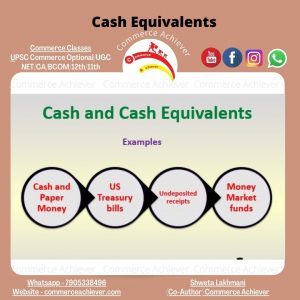
      Cash equivalents, also known as “cash and equivalents,” are one of the three main asset classes in financial investing, along with stocks and bonds. These securities have a low-risk, low-return profile and include Treasury Bills, bank certificates of deposit, bankers’ acceptance, corporate commercial paper, and other money market instruments.

      KEY POINTS

      • Cash equivalents are the total value of cash on hand that includes items that are similar to cash; cash and cash equivalents must be current assets.
      • A company’s combined cash or cash equivalents is always shown on the top line of the balance sheet since these assets are the most liquid assets.
      • Along with stocks and bonds, cash and cash equivalents make up the three main asset classes in finance.
      • These low-risk securities include  T-bills, bank CDs, bankers’ acceptances, corporate commercial paper, and other money market instruments.
      • Having cash and cash equivalents on hand speaks to a company’s health, as it reflects the firm’s ability to pay its short-term debt.

      Understanding Cash Equivalents

      Cash equivalents also serve as one of the most important health indicators of a company’s financial system. Analysts can also estimate whether it is good to invest in a particular company through its ability to generate cash and cash equivalents since it reflects how a company is able to pay its bills throughout a short period of time. Companies with large amounts of cash and cash equivalents are primary targets of bigger companies who are planning to acquire smaller companies.

      There are five types of cash equivalents: Treasury bills, commercial paper, marketable securities, money market funds, and short-term government bonds.

      Treasury Bills

      Treasury bills are commonly referred to as “T-bills.” These are securities issued by the United States Department of Treasury. When issued to companies, companies essentially lend the government money.

      Commercial Papers

      Commercial papers are used by big companies to receive funds to answer short-term debt obligations like a corporations’ payroll. They are supported by issuing banks or companies that promise to fulfill and pay the face amount on the designated maturity date provided on the note.

      Marketable Securities
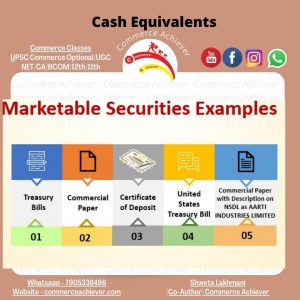
      Marketable securities are financial assets and instruments that can easily be converted into cash and are therefore very liquid. Marketable securities are liquid because maturities tend to happen within one year or less and the rates at which these may be traded have minimal effect on prices.

      Money Market Funds

      Money market funds are like checking accounts that pay higher interest rates provided by deposited money. Money market funds provide an efficient and effective tool for companies and organizations to manage their money since they tend to be more stable compared to other types of funds like mutual funds.

      Short-Term Government Bonds

      Short-term government bonds are provided by governments to fund government projects. These are issued using the country’s domestic currency. Investors take a look at political risks, interest rate risks, and inflation when investing in government bonds.

      Companies often store money in cash and cash equivalents in order to earn interest on the funds while they wait to use them. 

      What Cash Equivalents Are Used For

      There are several reasons a company might store their capital in cash equivalents. One, they are part of the company’s net working capital (current assets minus current liabilities), which it uses to buy inventory, cover operating expenses and make other purchases. They also provide a buffer for the company to quickly convert to cash if times become lean. Finally, they may be used to finance an acquisition.

      Tag:CAfoundation, CAfoundationaAccounts, CAfoundationClasses, CAfoundationEconomic, CAfoundationFees, CAfoundationLaw, CAfoundationRegistration, Cash equivalents, commerce, commerceachiever, CommerceAndAccountancy, CommerceBaba, Commercial Papers, Marketable Securities, Money Market Funds, Short-Term Government Bonds, Treasury Bills

      • Share:
      commerce achiever1

      Previous post

      Cash-Meaning,Historical form of Cash (Commerce Achiever)
      March 18, 2021

      Next post

      Cash Basis-Meaning,Example,Benefits Of Cash Basis of Accounting,Disadvantages of Cash Basis of Accounting,Choosing Between Cash Basis and Accrual accounting (Commerce Achiever)
      March 19, 2021

      You may also like

      functions & uses of Cost Accountant
      A medium size firm is making large profits and they do not have a Cost Accounting Department. There is a proposal to employ a Cost Accountant. What would you consider to be his functions and how can he make himself useful to the management
      June 16, 2023
      _Blog Post
      What are the functions of Cost Accounting?
      June 16, 2023
      UPSC Commerce and Accountancy Optional
      Commerce and Accountancy Optional Success Rate – UPSC Commerce & Accountancy Optional
      May 25, 2023
      • +91 7905338496
      • achievercommerce@gmail.com

      Our Subjects

      • UPSC Commerce Optional
      • UGC NET – Commerce Optional
      • Chartered Accountant
      • B.Com / M.Com
      • 11 Commerce
      • 12 Commerce

      Useful Links

      • Learn – Free
      • Income Tax
      • Economics
      • Accounts
      • Financial Management
      • HRM- Human Resource Management
      • Audit
      • Organization Behaviour
      • Industrial Relation (IR)
      • NCERT

      Subscribe

      Don’t lose out on any important Post and Update. Learn everyday with Experts!!

      Copyright © 2024-2025 Commerce Achiever | All Rights Reserved

      toto slot
      situs toto
      situs toto
      situs toto
      situs toto login
      toto slot
      toto slot
      idn slot
      slot hoki

      • Privacy
      • Terms
      • Sitemap
      • Purchase
      situs toto situs toto cerutu4d cerutu4d cerutu4d cerutu4d bo toto pulsa bo togel bo togel bo togel bo togel cerutu4d bandar toto macau bo toto situs togel situs togel cerutu4d cerutu4d cerutu4d cabe4d situs toto slot gacor situs togel situs toto agen toto situs togel situs toto situs togel resmi slot gacor slot gacor slot gacor
      situs toto situs toto cerutu4d cerutu4d cerutu4d cerutu4d bo toto pulsa bo togel bo togel bo togel bo togel cerutu4d bandar toto macau bo toto situs togel situs togel cerutu4d cerutu4d cerutu4d

      Login with your site account

      Lost your password?

      Message Us