• Home
  • Subjects
    • UPSC Commerce Optional
      • Syllabus – UPSC Commerce Optional
      • UPSC Commerce and Accountancy Optional Question Paper
      • Book
        • UPSC Commerce Optional Books – The Marathon of UPSC Commerce Optional
      • Blog
      • Courses
      • Answer Writing Practise
      • News
    • UGC NET – Commerce Optional
      • UGC NET – Syllabus
      • Past Papers
        • July 2018-Commerce
        • Dec 2017-Commerce
        • June 2017-Commerce
        • Dec 2016-Commerce
        • June 2016-Commerce
        • Dec 2015-Commerce
        • June 2015-Commerce
    • Chartered Accountant
      • Level-1 – Foundation
        • Syllabus
        • CA Level-1 Blog
      • Level-2 – Intermediate
        • Syllabus
        • CA Level-2 Blog
      • Level-3 – Final
        • Syllabus
        • CA Level-3 Blog
    • B.Com / M.Com
    • 11 Commerce
    • 12 Commerce
  • Blog
    • Income Tax
    • Economics
    • Accounts
    • Financial Management
    • HRM- Human Resource Management
    • Audit
    • Organization Behaviour
    • Industrial Relation (IR)
    • NCERT
      • 10th Class
      • 11th Class
      • 12th Class
      • 9th Class
  • Contact
    • Have any question?
    • +91 7905338496
    • achievercommerce@gmail.com
    Login
    Commerce Achiever
    • Home
    • Subjects
      • UPSC Commerce Optional
        • Syllabus – UPSC Commerce Optional
        • UPSC Commerce and Accountancy Optional Question Paper
        • Book
          • UPSC Commerce Optional Books – The Marathon of UPSC Commerce Optional
        • Blog
        • Courses
        • Answer Writing Practise
        • News
      • UGC NET – Commerce Optional
        • UGC NET – Syllabus
        • Past Papers
          • July 2018-Commerce
          • Dec 2017-Commerce
          • June 2017-Commerce
          • Dec 2016-Commerce
          • June 2016-Commerce
          • Dec 2015-Commerce
          • June 2015-Commerce
      • Chartered Accountant
        • Level-1 – Foundation
          • Syllabus
          • CA Level-1 Blog
        • Level-2 – Intermediate
          • Syllabus
          • CA Level-2 Blog
        • Level-3 – Final
          • Syllabus
          • CA Level-3 Blog
      • B.Com / M.Com
      • 11 Commerce
      • 12 Commerce
    • Blog
      • Income Tax
      • Economics
      • Accounts
      • Financial Management
      • HRM- Human Resource Management
      • Audit
      • Organization Behaviour
      • Industrial Relation (IR)
      • NCERT
        • 10th Class
        • 11th Class
        • 12th Class
        • 9th Class
    • Contact

      Accounts

      • Home
      • Blog
      • Learn - Free
      • Blogs
      • Accounts

      Depletion-Meaning,Four main factors that affect the depletion base,Percentage Depletion Method,Cost Depletion Method,

      • Posted by commerce achiever1
      • Categories Accounts, Blogs, Learn - Free
      • Date March 31, 2021

      Depletion is an accrual accounting technique used to allocate the cost of extracting natural resources such as timber, minerals, and oil from the earth. 

      Like depretiation and amortization, depletion is a non-cash expenses that lowers the cost value of an asset incrementally through scheduled charges to income. Where depletion differs is that it refers to the gradual exhaustion of natural resource reserves, as opposed to the wearing out of depreciable assets or aging life of intangibles.

      How Depletion Works

      Depletion for accounting and financial reporting purposes is meant to assist in accurately identifying the value of the assets on the balance sheet and recording expenses in the appropriate time period on the income statement.

      When the costs associated with natural resource extraction have been capitalized, the expenses are systematically allocated across different time periods based upon the resources extracted. The costs are held on the balance sheet until expense recognition occurs.

      KEY POINTS

      • Depletion is an accrual accounting method used to allocate the cost of extracting natural resources such as timber, minerals, and oil from the earth.
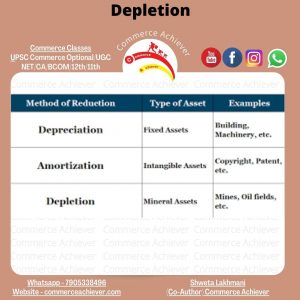
      • When the costs associated with natural resource extraction have been capitalized, the expenses are systematically allocated across different time periods based upon the resources extracted.
      • There are two basic forms of depletion allowance: percentage depletion and cost depletion.


      Recording Depletion

      To calculate what expenses need to be spread out for the use of natural resources, each different phase of production must be taken into consideration. The depletion base is the capitalized costs depleted across multiple accounting periods. There are four main factors that affect the depletion base:

      • Acquisition: Costs associated with purchasing or leasing the property rights to land that the company believes has natural resources.
      • Exploration: Expenses linked to digging under the land that was leased or bought.
      • Development: The costs necessary to prepare the land for natural resource extraction, such as tunneling or developing wells.
      • Restoration: Expenses associated with restoring the land to its original condition after completion.
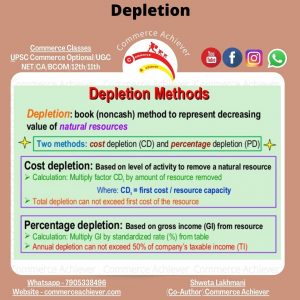
      Percentage Depletion Method

      One method of calculating depletion expense is the percentage depletion method. It assigns a fixed percentage to gross revenue — sales minus costs — to allocate expenses. For example, if $10 million of oil is extracted and the fixed percentage is 15%, $1.5 million of capitalized costs to extract the natural resource are depleted.

      The percentage depletion method requires a lot of estimates and is, therefore, not a heavily relied upon or accepted method of depletion.


      Cost Depletion Method

      The second method of calculating depletion is the cost depletion method. Cost depletion is calculated by taking the property’s basis, total recoverables reserves and number of units sold into account. The property’s basis is distributed among the total number of recoverable units. As natural resources are extracted, they are counted and taken out from the property’s basis.

      For example, the capitalized costs of $1 million yields 500,000 barrels of oil. In the first year, if 100,000 barrels of oil are extracted, the depletion expense for the period is $200,000 (100,000 barrels * ($1,000,000 / 500,000 barrels)


      Reporting Requirements

      The Internal Revenue Services (IRS) requires the cost method to be used with timber.1 It requires the method that yields the highest deduction to be used with mineral property, which it defines as oil and gas wells, mines and other natural deposits, including geothermal deposits.

      Because the percentage depletion looks at the property’s gross income and taxable income limit, as opposed to the amount of the natural resource extracted, it is not an acceptable reporting method for certain natural resources.

      Tag:Acquisition, CAfoundation, CAfoundationaAccounts, CAfoundationClasses, CAfoundationEconomic, CAfoundationFees, CAfoundationLaw, CAfoundationRegistration, commerce, commerceachiever, CommerceAndAccountancy, CommerceBaba, Cost Depletion Method, Depletion, Development, Exploration, Percentage Depletion Method, Restoration

      • Share:
      commerce achiever1

      Previous post

      Deficit-Meaning,Types,Risks and Benefits of Running a Deficit (Commerce Achiever)
      March 31, 2021

      Next post

      Depreciation-Meaning,Types of Depreciation,Examples,Units of production (Commerce Achiever)
      March 31, 2021

      You may also like

      functions & uses of Cost Accountant
      A medium size firm is making large profits and they do not have a Cost Accounting Department. There is a proposal to employ a Cost Accountant. What would you consider to be his functions and how can he make himself useful to the management
      June 16, 2023
      _Blog Post
      What are the functions of Cost Accounting?
      June 16, 2023
      UPSC Commerce and Accountancy Optional
      Commerce and Accountancy Optional Success Rate – UPSC Commerce & Accountancy Optional
      May 25, 2023
      • +91 7905338496
      • achievercommerce@gmail.com

      Our Subjects

      • UPSC Commerce Optional
      • UGC NET – Commerce Optional
      • Chartered Accountant
      • B.Com / M.Com
      • 11 Commerce
      • 12 Commerce

      Useful Links

      • Learn – Free
      • Income Tax
      • Economics
      • Accounts
      • Financial Management
      • HRM- Human Resource Management
      • Audit
      • Organization Behaviour
      • Industrial Relation (IR)
      • NCERT

      Subscribe

      Don’t lose out on any important Post and Update. Learn everyday with Experts!!

      Copyright © 2024-2025 Commerce Achiever | All Rights Reserved

      toto slot
      situs toto
      situs toto
      situs toto
      situs toto login
      toto slot
      toto slot
      idn slot
      slot hoki

      • Privacy
      • Terms
      • Sitemap
      • Purchase
      situs toto situs toto cerutu4d cerutu4d cerutu4d cerutu4d bo toto pulsa bo togel bo togel bo togel bo togel cerutu4d bandar toto macau bo toto situs togel situs togel cerutu4d cerutu4d cerutu4d cabe4d situs toto slot gacor situs togel situs toto agen toto situs togel situs toto situs togel resmi slot gacor slot gacor slot gacor
      situs toto situs toto cerutu4d cerutu4d cerutu4d cerutu4d bo toto pulsa bo togel bo togel bo togel bo togel cerutu4d bandar toto macau bo toto situs togel situs togel cerutu4d cerutu4d cerutu4d

      Login with your site account

      Lost your password?

      Message Us