• Home
  • Subjects
    • UPSC Commerce Optional
      • Syllabus – UPSC Commerce Optional
      • UPSC Commerce and Accountancy Optional Question Paper
      • Book
        • UPSC Commerce Optional Books – The Marathon of UPSC Commerce Optional
      • Blog
      • Courses
      • Answer Writing Practise
      • News
    • UGC NET – Commerce Optional
      • UGC NET – Syllabus
      • Past Papers
        • July 2018-Commerce
        • Dec 2017-Commerce
        • June 2017-Commerce
        • Dec 2016-Commerce
        • June 2016-Commerce
        • Dec 2015-Commerce
        • June 2015-Commerce
    • Chartered Accountant
      • Level-1 – Foundation
        • Syllabus
        • CA Level-1 Blog
      • Level-2 – Intermediate
        • Syllabus
        • CA Level-2 Blog
      • Level-3 – Final
        • Syllabus
        • CA Level-3 Blog
    • B.Com / M.Com
    • 11 Commerce
    • 12 Commerce
  • Blog
    • Income Tax
    • Economics
    • Accounts
    • Financial Management
    • HRM- Human Resource Management
    • Audit
    • Organization Behaviour
    • Industrial Relation (IR)
    • NCERT
      • 10th Class
      • 11th Class
      • 12th Class
      • 9th Class
  • Contact
    • Have any question?
    • +91 7905338496
    • achievercommerce@gmail.com
    Login
    Commerce Achiever
    • Home
    • Subjects
      • UPSC Commerce Optional
        • Syllabus – UPSC Commerce Optional
        • UPSC Commerce and Accountancy Optional Question Paper
        • Book
          • UPSC Commerce Optional Books – The Marathon of UPSC Commerce Optional
        • Blog
        • Courses
        • Answer Writing Practise
        • News
      • UGC NET – Commerce Optional
        • UGC NET – Syllabus
        • Past Papers
          • July 2018-Commerce
          • Dec 2017-Commerce
          • June 2017-Commerce
          • Dec 2016-Commerce
          • June 2016-Commerce
          • Dec 2015-Commerce
          • June 2015-Commerce
      • Chartered Accountant
        • Level-1 – Foundation
          • Syllabus
          • CA Level-1 Blog
        • Level-2 – Intermediate
          • Syllabus
          • CA Level-2 Blog
        • Level-3 – Final
          • Syllabus
          • CA Level-3 Blog
      • B.Com / M.Com
      • 11 Commerce
      • 12 Commerce
    • Blog
      • Income Tax
      • Economics
      • Accounts
      • Financial Management
      • HRM- Human Resource Management
      • Audit
      • Organization Behaviour
      • Industrial Relation (IR)
      • NCERT
        • 10th Class
        • 11th Class
        • 12th Class
        • 9th Class
    • Contact

      Accounts

      • Home
      • Blog
      • Learn - Free
      • Blogs
      • Accounts

      Extraordinary items -Meaning,Example,Understanding Extraordinary items (Commerce Achiever)
      • Posted by commerce achiever1
      • Categories Accounts, Blogs, Learn - Free
      • Date April 1, 2021

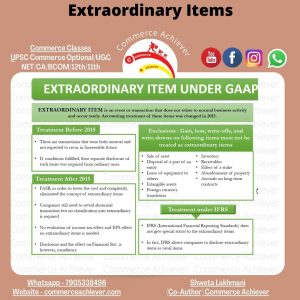
      Extraordinary items consisted of gains or losses from events that were unusual and infrequent in nature that were separately classified, presented and disclosed on companies’ financial statements. Extraordinary items were usually explained further in the notes to the financial statements. Companies showed an extraordinary item separately from their operating earnings because it was typically a one-time gain or loss and was not expected to recur in the future.

      In January 2015, the Financial Accounting Standards Board (FASB), which issues the accounting standards that U.S. companies must comply with, eliminated the concept of extraordinary items. However, companies must still report non-recurring items such as income received from the sale of land.

      KEY POINTS

      • Extraordinary items were gains or losses from infrequent and unusual events that were separately classified on companies’ financial statements.
      • In January 2015, the Financial Accounting Standards Board (FASB) eliminated the concept of extraordinary items.1
      • FASB discontinued the accounting treatment for extraordinary items to reduce the cost and complexity of preparing financial statements.

      Understanding Extraordinary Item

      The accounting standards established and updated by FASB are called the Generally Accepted Accounting Principles (GAAP). FASB discontinued the accounting treatment for extraordinary items and removed the reporting requirement from U.S. GAAP in order to reduce the cost and complexity of preparing financial statements.

      Before 2015, companies put a lot of effort into determining if a particular event should be deemed extraordinary. Gains and losses net of taxes from extraordinary items had to be shown separately on the income statement after income from continuing operations.

      The update by FASB to remove extraordinary items only eliminated the need for companies and their auditors to identify whether an event was so rare as to qualify as an extraordinary item starting in fiscal year 2015. Companies must still disclose infrequent and unusual events but now without designating them as extraordinary. Also, companies are no longer required to evaluate the income tax effect of extraordinary items and present the effect on Earnings per share (EPS), which is a company’s profit as a proportion of its outstanding equity shares.

      This accounting update left reporting and disclosure requirements for unusual and infrequent events or transactions intact. While companies no longer must describe events and their effects as extraordinary, they still have to disclose infrequent and unusual events on the income statement and their effect before income taxes. Also, GAAP allows companies to give these events more specific names, such as “Effects From Fire at Production Facility.” The International Financial Reporting Standards (IFRS) do not include extraordinary items in their accounting standards.

      Requirements for an Extraordinary Item

      An event or transaction was deemed extraordinary if it was both unusual and infrequent. An unusual event must be highly abnormal and unrelated to the typical operating activities of a company, and it should be reasonably expected not to recur going forward. It was common for some businesses to not have this line item presented for years.

      Besides segregating the effect of extraordinary items on the income statement, companies were required to estimate income taxes from these items and disclose their earnings-per-share (EPS) impact. Examples of extraordinary items are losses from various catastrophic events, such as earthquakes, tsunamis, and wildfires. While designating and estimating the effect from certain extraordinary events (e.g., fires) was easy, other events with an indirect effect on companies’ operations were much more difficult to assess.

      Tag:CAfoundation, CAfoundationaAccounts, CAfoundationClasses, CAfoundationEconomic, CAfoundationFees, CAfoundationLaw, CAfoundationRegistration, commerce, commerceachiever, CommerceAndAccountancy, CommerceBaba, Extraordinary Items

      • Share:
      commerce achiever1

      Previous post

      Expense-Meaning,Operating,Non-operating Expense (Commerce Achiever)
      April 1, 2021

      Next post

      Fair Value-Meaning,Example,Fair Value and Financial Statements,Fair Value and Market Value (Commerce Achiever)
      April 2, 2021

      You may also like

      functions & uses of Cost Accountant
      A medium size firm is making large profits and they do not have a Cost Accounting Department. There is a proposal to employ a Cost Accountant. What would you consider to be his functions and how can he make himself useful to the management
      June 16, 2023
      _Blog Post
      What are the functions of Cost Accounting?
      June 16, 2023
      UPSC Commerce and Accountancy Optional
      Commerce and Accountancy Optional Success Rate – UPSC Commerce & Accountancy Optional
      May 25, 2023
      • +91 7905338496
      • achievercommerce@gmail.com

      Our Subjects

      • UPSC Commerce Optional
      • UGC NET – Commerce Optional
      • Chartered Accountant
      • B.Com / M.Com
      • 11 Commerce
      • 12 Commerce

      Useful Links

      • Learn – Free
      • Income Tax
      • Economics
      • Accounts
      • Financial Management
      • HRM- Human Resource Management
      • Audit
      • Organization Behaviour
      • Industrial Relation (IR)
      • NCERT

      Subscribe

      Don’t lose out on any important Post and Update. Learn everyday with Experts!!

      Copyright © 2024-2025 Commerce Achiever | All Rights Reserved

      toto slot
      situs toto
      situs toto
      situs toto
      situs toto login
      toto slot
      toto slot
      idn slot
      slot hoki

      • Privacy
      • Terms
      • Sitemap
      • Purchase
      situs toto situs toto cerutu4d cerutu4d cerutu4d cerutu4d bo toto pulsa bo togel bo togel bo togel bo togel cerutu4d bandar toto macau bo toto situs togel situs togel cerutu4d cerutu4d cerutu4d cabe4d situs toto slot gacor situs togel situs toto agen toto situs togel situs toto situs togel resmi slot gacor slot gacor slot gacor
      situs toto situs toto cerutu4d cerutu4d cerutu4d cerutu4d bo toto pulsa bo togel bo togel bo togel bo togel cerutu4d bandar toto macau bo toto situs togel situs togel cerutu4d cerutu4d cerutu4d

      Login with your site account

      Lost your password?

      Message Us