

Fixed Assets-Meaning,Exampels,Fixed Assets vs. Current Assets,Fixed Assets vs. Noncurrent Assets,Benefits of Fixed assets (Commerce Achiever)
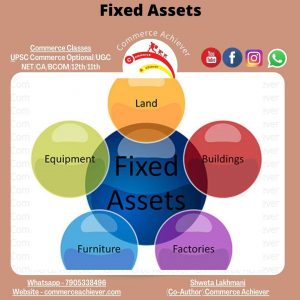 A fixed asset is a long-term tangible piece of property or equipment that a firm owns and uses in its operations to generate income. Fixed assets are not expected to be consumed or converted into cash within a year. Fixed assets most commonly appear on the balance sheet as Property,Plant & Equipment (PP&E). They are also referred to as capital assets.
- Fixed assets are items, such as property or equipment, a company plans to use over the long-term to help generate income.
- Fixed assets are most commonly referred to as property, plant, and equipment (PP&E).
- Current assets, such as inventory, are expected to be converted to cash or used within a year.
- Noncurrent assets, in addition to fixed assets, include intangibles and long-term investments.
- Fixed assets are subject to depreciation to account for the loss in value as the assets are used, whereas intangibles are amortized.
Understanding Fixed Asset
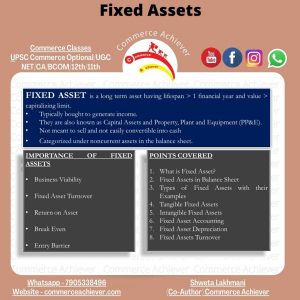
A company’s balance sheet statement includes its assets, liabilities, and shareholders’ equity. Assets are divided into current assets and non current assets, the difference for which lies in their useful lives. Current assets are typically liquid assets that will be converted into cash in less than a year. Noncurrent assets refer to assets and property owned by a business that are not easily converted to cash. The different categories of noncurrent assets include fixed assets, intangible assets, long-term investments, and deffered charges.
A fixed asset is bought for production or supply of goods or services, rental to third parties, or use in an organization. The term “fixed” translates to the fact that these assets will not be used up or sold within the accounting year. A fixed asset typically has a physical form and is reported on the balance sheet as PP&E.
When a company acquires or disposes of a fixed asset, this is recorded on the cash flow statement under the cash flow from investing activities. The purchase of fixed assets represents a cash outflow to the company while a sale is a cash inflow. If the asset’s value falls below its net book value, the asset is subject to an impairement write-down. This means that its recorded value on the balance sheet is adjusted downward to reflect that it is overvalued compared to the market value.
When a fixed asset has reached the end of its useful life, it is usually disposed of by selling it for a salvage value, which is the asset’s estimated value if it was broken down and sold in parts. In some cases, the asset may become obsolete and will, therefore, be disposed of without receiving any payment in return. Either way, the fixed asset is written off the balance sheet as it is no longer in use by the company.
Fixed Assets vs. Current Assets
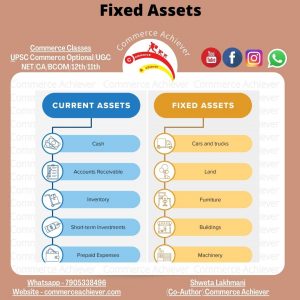
Both current assets and fixed assets appear on the balance sheet, with current assets meant to be used or converted to cash in the short term (less than one year) and fixed assets meant to be used over the longer term (more than one year). Current assets include cash and cash equivalents, accounts recievables, inventory, and prepaid expenses. Fixed assets are depreciated, while current assets are not.
Fixed Assets vs. Noncurrent Assets
Fixed assets are a noncurrent assets. Other noncurrent assets include long-term investments and intangibles. Intangible assets are fixed assets to be used over the long term, but they lack physical existence. Examples of intangible assets include goodwill, copyrights, trademarks, and intellectual property. Meanwhile, long-term investments can include bond investments that will not be sold or mature within a year.
Benefits of Fixed Assets
Information about a corporation’s assets helps create accurate financial reporting, business valuations, and thorough financial analysis. Investors and creditors use these reports to determine a company’s financial health and decide whether to buy shares in or lend money to the business. Because a company may use a range of accepted methods for recording, depreciating, and disposing of its assets, analysts need to study the notes on the corporation’s financial statements to find out how the numbers were determined.
Fixed assets are particularly important to capital-intensives industries, such as manufacturing, which require large investments in PP&E. When a business is reporting persistently negative net cash flows for the purchase of fixed assets, this could be a strong indicator that the firm is in growth or investment mode.
Examples of Fixed Assets
Fixed assets can include buildings, computer equipment, software, furniture, land, machinery, and vehicles. For example, if a company sells produce, the delivery trucks it owns and uses are fixed assets. If a business creates a company parking lot, the parking lot is a fixed asset. Note that a fixed asset does not necessarily have to be “fixed” in all senses of the word. Some of these types of assets can be moved from one location to another, such as furniture and computer equipment.
Special Considerations
Fixed assets lose value as they age. Because they provide long-term income, these assets are expensed differently than other items. Tangible assets are subject to periodic depreciation, and intangible assets are subject to amortization. A certain amount of an asset’s cost is expensed annually. The asset’s value decreases along with its depreciation amount on the company’s balance sheet. The corporation can then match the asset’s cost with its long-term value.
How a business depreciates an asset can cause its book value—the asset value that appears on the balance sheet—to differ from the current market value at which the asset could sell. Land cannot be depreciated.
What’s the Difference Between Fixed Assets and Current Assets?
Fixed assets, a type of noncurrent asset, are long-term tangible pieces of property or equipment that a firm owns and uses in its operations to generate income. They are not expected to be consumed or converted into cash within one year, are subject to depreciation, and are illiquid.
Fixed assets, also referred to as capital assets, are particularly important to capital-intensive industries, such as manufacturing, which require large investments in property, plant, and equipment (PP&E).
Current assets are meant to be used or converted to cash in the short term, defined as less than one year and are not depreciated. Current assets include cash and cash equivalents, accounts receivable, inventory, and prepaid expenses. Fixed assets are depreciated, while current assets are not. Both current assets and fixed assets appear on the balance sheet,
What Are Examples of Fixed Assets?
Fixed assets can include buildings, computer equipment, software, furniture, land, machinery, and vehicles. For example, if a company sells produce, the delivery trucks it owns and uses are fixed assets. Note that a fixed asset does not necessarily have to be “fixed” in all senses of the word. Some of these types of assets can be moved from one location to another, such as furniture and computer equipment.
Where Are Other Types of Noncurrent Assets?
Other noncurrent assets include long-term investments and intangibles. Intangible assets are fixed assets to be used over the long term, but they lack physical existence. Examples of intangible assets include goodwill, copyrights, trademarks, and intellectual property. Meanwhile, long-term investments can include bond investments that will not be sold or mature within a year.

You may also like


