

Fundamental Accounting Assumptions-Meaning,Types-Going Concern,Consistency,Accrual (Commerce Achiever)
 At the time of preparing financial statements of a company, there are some fundamental accounting assumptions. In case if they are not mentioned, it will be presumed that these accounting assumptions are followed in the financial statements.
So let us discuss these fundamental accounting assumptions in brief:
Fundamental Accounting Assumptions
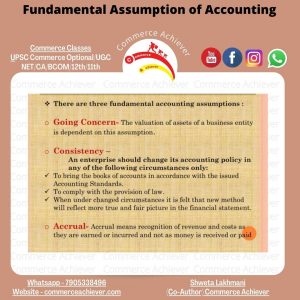 There are three fundamental accounting assumptions that are presumed to be followed in every accounting transactions of an entity. Howsoever, it is not important that the business has followed these fundamental accounting assumptions. In a case, if a business does not follow these assumptions then the company shall disclose all the relevant financial transactions, together with the financial statements.
According to the accounting standard of India, here are the 3 fundamental accounting assumptions:
Going Concern:
As the name suggests “Going Concern” means ‘with the expectation of continuing indefinitely’. This concept underlines the assumption that the enterprise has neither any intention nor any necessity to close the business. The chances to cease to operate the business are too remote. Accounting is always done with a view that business entity will last for a long time.
Accordingly, fixed assets are depreciated for a long time i.e. till their useful life. If this assumption is not considered, the whole cost of the fixed asset would be treated as an expense in the year in which that fixed asset is purchased.
Based on Going Concern, the cost of the fixed asset is treated over the cost of the total years in which asset would give benefit from its usage. Deferred Advertising Expenditure is another example which is incurred in lump-sum and the benefits accrue indefinitely.
Such expenditures are not charged in a single year’s profits and are rather written off during the life of the business or the number of years we expect the likely benefits to accrue from it. Parties interested in the business will stay connected only when the longevity of the concern is assured. Otherwise they will be too scared to trust the continuity and availability of quality products.
Need:
The going concern assumption inspires and motivates the entrepreneurs to work with their full potential. If the entrepreneur himself is doubtful of the longevity of the business enterprise, regular and increased earnings are doubtful because he will not plough back the profits into the business. He will not employ further capital in the business.
Classification of long-term assets and current assets, long-term liabilities and current liabilities, long-term investments for obtaining higher rate of returns etc. will not arise. The outsiders will not associate with the business for long-term contracts. In these circumstances, even the continuity of the business enterprise is doubtful not to speak of any expansion.
Limitations:Despite the significance of this assumption, it is not free from following shortcomings:
Firstly, the financial statements are prepared on the assumption that the business will carry out its activities indefinitely i.e., for a long indefinite period. However, in many cases it can be seen that business enterprises close down their business activities after giving their financial statements. It only means that the results of the financial statements are misleading.
Secondly, final position of the business can be known when the enterprise goes into liquidation. In that circumstance, there is hardly any use of such information.
2. Consistency (Consistency Convention):
This assumption proposes to keep the methodology, policies of the business consistent and unchanged, so as to draw conclusions and facilitate decision making. In policy formulation, it is necessary that both inter-firm and inter-period (intra-firm) comparisons should be made. These comparisons can be possible when during the period of comparison; same methodology and policies are adopted by different entities.
Hence, in order to enable the management to draw important conclusions on the operations of a company over a couple of years, it is necessary that the accounting practices and methods remain unchanged during all accounting periods in question.
However, it should be noted that this concept should not be looked at as a method of non- flexibility. It is worth mentioning here that discarding an old and inappropriate technique is always welcomed. Here, it is important to make a distinction between clauses and adjustments which appear as being inconsistent but actually they are not.
For instance, inventory (stock) is valued at cost or realizable value, whichever is lower. It might sound like an inconsistent clause but actually is not. Rather it is just an application of the Accounting Standards issued by Institute of Chartered Accountants of India. As against this, take a case of provision for doubtful debts. In one year the business enterprise has estimated doubtful debts on percentage basis and in the other year on age old basis. This seems absolutely fair in terms but is actually inconsistent.
Need:
Consistency is equally important as a basic assumption of accounting because it helps in decision making function of the management. It also helps other users of accounting information to take decisions related to their interest.
Limitations:
There are several accounting methods for different methods and it is not possible that the all the entities in the same trade use the same techniques. For example, for valuation of stock, one entity may select First-in-First-out (FIFO) method and other entity may select Last-in-First- out (LIFO) method. But in both the cases the results would be different. Business entities also switch over from one method to other very frequently. In those circumstances a meaningful conclusion cannot be drawn.
To overcome the above limitations, it is necessary that any changes in the policy of the company or financial statements should be well informed to the users and the method once adopted by the entity should be followed by them at least for some years so that trend of the operational efficiency can be evaluated.
3. Accrual:
Accrual concept says that revenue is recognized when it is realized and expenses are recognized in that accounting period in which they facilitate to earn the revenue. In both the cases it should not be the criteria whether actual cash is received or not (in case of revenue) and actual cash is paid or not (in case of expenses). In this sense, a mere promise to pay is also considered revenue from the point of view of receiver and expense from the point of view of payer.
Need:
The basic objective of accrual concept is that earning of revenues and expenses (i.e., consumption of resources ) can definitely be related to a particular accounting period, so revenue and expenses should be considered as earned and incurred respectively on accrual basis instead of cash basis.
Limitations:The main limitations of this concept are as under:
(i) Allocation of revenue and expenses between different years on the basis of accrual is a time consuming process.
(ii) In the case of goods sold on the basis of hire purchase system, the amount collected in each year as installment is treated as the revenue realized during that particular year instead of total selling price.

You may also like


