• Home
  • Subjects
    • UPSC Commerce Optional
      • Syllabus – UPSC Commerce Optional
      • UPSC Commerce and Accountancy Optional Question Paper
      • Book
        • UPSC Commerce Optional Books – The Marathon of UPSC Commerce Optional
      • Blog
      • Courses
      • Answer Writing Practise
      • News
    • UGC NET – Commerce Optional
      • UGC NET – Syllabus
      • Past Papers
        • July 2018-Commerce
        • Dec 2017-Commerce
        • June 2017-Commerce
        • Dec 2016-Commerce
        • June 2016-Commerce
        • Dec 2015-Commerce
        • June 2015-Commerce
    • Chartered Accountant
      • Level-1 – Foundation
        • Syllabus
        • CA Level-1 Blog
      • Level-2 – Intermediate
        • Syllabus
        • CA Level-2 Blog
      • Level-3 – Final
        • Syllabus
        • CA Level-3 Blog
    • B.Com / M.Com
    • 11 Commerce
    • 12 Commerce
  • Blog
    • Income Tax
    • Economics
    • Accounts
    • Financial Management
    • HRM- Human Resource Management
    • Audit
    • Organization Behaviour
    • Industrial Relation (IR)
    • NCERT
      • 10th Class
      • 11th Class
      • 12th Class
      • 9th Class
  • Contact
    • Have any question?
    • +91 7905338496
    • achievercommerce@gmail.com
    Login
    Commerce Achiever
    • Home
    • Subjects
      • UPSC Commerce Optional
        • Syllabus – UPSC Commerce Optional
        • UPSC Commerce and Accountancy Optional Question Paper
        • Book
          • UPSC Commerce Optional Books – The Marathon of UPSC Commerce Optional
        • Blog
        • Courses
        • Answer Writing Practise
        • News
      • UGC NET – Commerce Optional
        • UGC NET – Syllabus
        • Past Papers
          • July 2018-Commerce
          • Dec 2017-Commerce
          • June 2017-Commerce
          • Dec 2016-Commerce
          • June 2016-Commerce
          • Dec 2015-Commerce
          • June 2015-Commerce
      • Chartered Accountant
        • Level-1 – Foundation
          • Syllabus
          • CA Level-1 Blog
        • Level-2 – Intermediate
          • Syllabus
          • CA Level-2 Blog
        • Level-3 – Final
          • Syllabus
          • CA Level-3 Blog
      • B.Com / M.Com
      • 11 Commerce
      • 12 Commerce
    • Blog
      • Income Tax
      • Economics
      • Accounts
      • Financial Management
      • HRM- Human Resource Management
      • Audit
      • Organization Behaviour
      • Industrial Relation (IR)
      • NCERT
        • 10th Class
        • 11th Class
        • 12th Class
        • 9th Class
    • Contact

      Accounts

      • Home
      • Blog
      • Learn - Free
      • Blogs
      • Accounts

      Provision-Meaning,Understanding,Examples,Types,Requirements for creating provision,Accounting Treatment of Provision (Commerce Achiever)

      • Posted by commerce achiever1
      • Categories Accounts, Blogs, Learn - Free
      • Date April 16, 2021

      Provisions in accounting refer to the amount that is generally put aside from the profit in order to meet a probable future expense or a reduction in the asset value although the exact amount is unknown.

      Provision cannot be seen as savings, but it can be regarded as a way of recognising any upcoming or future liabilities.

      Most of the time, provision is treated as a reserve, but reserve and provision are not interchangeable. A provision is set up to cover probable future liabilities while a reserve is a part of the profit that is set aside for assisting the company’s growth and expansion.

      Provisions in Accounting
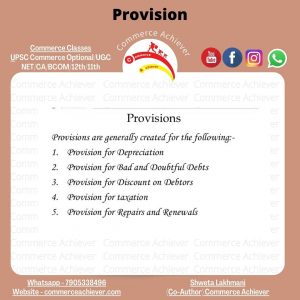
      It is stated in the matching principle that it is mandatory to report all expenses incurred in a financial year along with the revenue earned. This is essential as it will become misleading if cost belonging to a certain year is recorded in previous or future balance sheets.

      Provisions, therefore, balance the current year balance to become more accurate by ensuring expenses are included along with revenues in the same accounting period.

      Examples of Provisions in accounting


      Bad debt is one of the most common types of provisions. It is calculated to cover the cost of debts that are expected to remain unpaid during an accounting period.
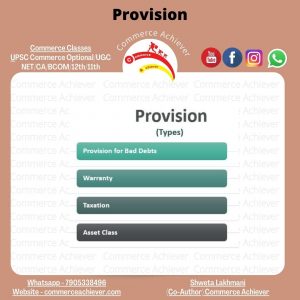
      The other examples of provisions are

      1. Doubtful debts
      2. Depreciation
      3. Pension
      4. Restructuring liabilities
      5. Income taxes
      6. Guarantee (product warranties)

      Requirements for creating provision

      A provision can be created due to a number of factors. However, there are certain requirements that must be met before a financial obligation can be considered as a provision.

      The following requirements are mentioned below:

      1. The organisation should perform a detailed amount of regulatory measurement for the obligation, and it should be performed by the management.
      2. An obligation must be determined as such, it is probable to occur, but not certain to occur. It should have more than 50% chance of occurring.
      3. The obligation must result in a decrease in the financial position of the business.

      Accounting Treatment of Provision

      Accounting treatment of provision can be understood with the example of presenting a written off bad debt in the account books.

      Bad debt expense A/c Dr 50000

      To Bad debt provision A/c 50000

      Tag:Accounting Treatment of Provision, CAfoundation, CAfoundationaAccounts, CAfoundationClasses, CAfoundationEconomic, CAfoundationFees, CAfoundationLaw, CAfoundationRegistration, commerce, commerceachiever, CommerceAndAccountancy, CommerceBaba, Provision

      • Share:
      commerce achiever1

      Previous post

      Promissory Notes-Meaning,Understanding,Examples,Types,Student Loan Promissory Notes,Promissory Notes vs. Traditional Lenders,Mortgages vs. Promissory Notes,The Tax Perspective (Commerce Achiever)
      April 16, 2021

      Next post

      UPSC Commerce and Accountancy NEWS | March 2021 |
      April 17, 2021

      You may also like

      functions & uses of Cost Accountant
      A medium size firm is making large profits and they do not have a Cost Accounting Department. There is a proposal to employ a Cost Accountant. What would you consider to be his functions and how can he make himself useful to the management
      June 16, 2023
      _Blog Post
      What are the functions of Cost Accounting?
      June 16, 2023
      UPSC Commerce and Accountancy Optional
      Commerce and Accountancy Optional Success Rate – UPSC Commerce & Accountancy Optional
      May 25, 2023
      • +91 7905338496
      • achievercommerce@gmail.com

      Our Subjects

      • UPSC Commerce Optional
      • UGC NET – Commerce Optional
      • Chartered Accountant
      • B.Com / M.Com
      • 11 Commerce
      • 12 Commerce

      Useful Links

      • Learn – Free
      • Income Tax
      • Economics
      • Accounts
      • Financial Management
      • HRM- Human Resource Management
      • Audit
      • Organization Behaviour
      • Industrial Relation (IR)
      • NCERT

      Subscribe

      Don’t lose out on any important Post and Update. Learn everyday with Experts!!

      Copyright © 2024-2025 Commerce Achiever | All Rights Reserved

      toto slot
      situs toto
      situs toto
      situs toto
      situs toto login
      toto slot
      toto slot
      idn slot
      slot hoki

      • Privacy
      • Terms
      • Sitemap
      • Purchase
      situs toto situs toto cerutu4d cerutu4d cerutu4d cerutu4d bo toto pulsa bo togel bo togel bo togel bo togel cerutu4d bandar toto macau bo toto situs togel situs togel cerutu4d cerutu4d cerutu4d cabe4d situs toto slot gacor situs togel situs toto agen toto situs togel situs toto situs togel resmi slot gacor slot gacor slot gacor
      situs toto situs toto cerutu4d cerutu4d cerutu4d cerutu4d bo toto pulsa bo togel bo togel bo togel bo togel cerutu4d bandar toto macau bo toto situs togel situs togel cerutu4d cerutu4d cerutu4d

      Login with your site account

      Lost your password?

      Message Us