• Home
  • Subjects
    • UPSC Commerce Optional
      • Syllabus – UPSC Commerce Optional
      • UPSC Commerce and Accountancy Optional Question Paper
      • Book
        • UPSC Commerce Optional Books – The Marathon of UPSC Commerce Optional
      • Blog
      • Courses
      • Answer Writing Practise
      • News
    • UGC NET – Commerce Optional
      • UGC NET – Syllabus
      • Past Papers
        • July 2018-Commerce
        • Dec 2017-Commerce
        • June 2017-Commerce
        • Dec 2016-Commerce
        • June 2016-Commerce
        • Dec 2015-Commerce
        • June 2015-Commerce
    • Chartered Accountant
      • Level-1 – Foundation
        • Syllabus
        • CA Level-1 Blog
      • Level-2 – Intermediate
        • Syllabus
        • CA Level-2 Blog
      • Level-3 – Final
        • Syllabus
        • CA Level-3 Blog
    • B.Com / M.Com
    • 11 Commerce
    • 12 Commerce
  • Blog
    • Income Tax
    • Economics
    • Accounts
    • Financial Management
    • HRM- Human Resource Management
    • Audit
    • Organization Behaviour
    • Industrial Relation (IR)
    • NCERT
      • 10th Class
      • 11th Class
      • 12th Class
      • 9th Class
  • Contact
    • Have any question?
    • +91 7905338496
    • achievercommerce@gmail.com
    Login
    Commerce Achiever
    • Home
    • Subjects
      • UPSC Commerce Optional
        • Syllabus – UPSC Commerce Optional
        • UPSC Commerce and Accountancy Optional Question Paper
        • Book
          • UPSC Commerce Optional Books – The Marathon of UPSC Commerce Optional
        • Blog
        • Courses
        • Answer Writing Practise
        • News
      • UGC NET – Commerce Optional
        • UGC NET – Syllabus
        • Past Papers
          • July 2018-Commerce
          • Dec 2017-Commerce
          • June 2017-Commerce
          • Dec 2016-Commerce
          • June 2016-Commerce
          • Dec 2015-Commerce
          • June 2015-Commerce
      • Chartered Accountant
        • Level-1 – Foundation
          • Syllabus
          • CA Level-1 Blog
        • Level-2 – Intermediate
          • Syllabus
          • CA Level-2 Blog
        • Level-3 – Final
          • Syllabus
          • CA Level-3 Blog
      • B.Com / M.Com
      • 11 Commerce
      • 12 Commerce
    • Blog
      • Income Tax
      • Economics
      • Accounts
      • Financial Management
      • HRM- Human Resource Management
      • Audit
      • Organization Behaviour
      • Industrial Relation (IR)
      • NCERT
        • 10th Class
        • 11th Class
        • 12th Class
        • 9th Class
    • Contact

      Accounts

      • Home
      • Blog
      • Learn - Free
      • Blogs
      • Accounts

      Carrying amount(Carrying Value)-Meaning,Calculation formula,Depreciation in the Carrying Amount (Commerce Achiever)

      • Posted by commerce achiever1
      • Categories Accounts, Blogs, Learn - Free
      • Date March 22, 2021

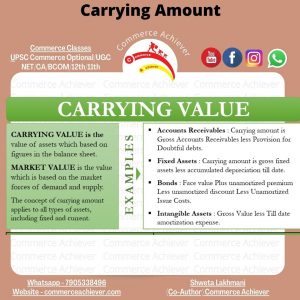
      Carrying value is an accounting measure of value in which the value of an asset or company is based on the figures in the respective company’s balance sheet. For physical assets, such as machinery or computer hardware, carrying cost is calculated as (original cost – accumulated depreciation). If a company purchases a patent or some other intellectual property item, then the formula for carrying value is (original cost – amortization expense).

      KEY POINTS
      • Carrying value is a measure of value for a company’s assets.
      • Carrying value is typically measured as the original cost of the asset, minus any depreciating factors. The depreciating factors for an asset vary based on the nature of the asset.
      • Some assets, such as land, are not considered depreciable. 
      • Rates of depreciation for an asset are influenced by the calculations of the company by which it is owned. 

      How Carrying Value Works

      Carrying amount, also known as carrying value, is the cost of an asset less accumulated depreciation. The carrying amount is usually not included on the balance sheet, as it must be calculated. However, the carrying amount is generally always lower than the current market value. 

      Accounting practice states that original cost is used to record assets on the balance sheet, rather than market value, because the original cost can be traced to a purchase document, such as a receipt. Market value is more subjective. At the initial acquisition of an asset, the carrying value of that asset is the original cost of its purchase. However, over time, the value of an asset will change. 

      Both depreciation and amortization expenses are used to recognize the decline in value of an asset as the item is used over time to generate revenue. Note that, while buildings depreciate, the land is not a depreciable asset. This is due to the fact that land is often considered to have an unlimited useful life, meaning that the value of the land will not depreciate over time. 
      Although land is considered non-depreciable, factors such as improvements made to the land—as well as buildings and equipment present on the land—means that the overall carrying value of land can still depreciate. 

      How to Calculate for Carrying Amount

      It is a very simple task to calculate for carrying amount, as shown in the example above. But to make it clearer, let’s explain it below:

      • Take the original cost of purchasing the asset less salvage value.
      • Divide that number by the number of years the asset is expected to be of use to generate the annual depreciation amount and record annually.
      • Calculate the accumulated depreciation (number of years past * annual depreciation)
      • Subtract the accumulated depreciation from the original purchase price to get the carrying amount.

      Depreciation in the Carrying Amount

      Depreciation is the lowering of the value of a tangible asset because of wear and tear. Tangible assets include buildings, equipment, furniture, and vehicles. One of the easiest and most commonly accepted methods of computing for depreciation is the straight line depreciation method. Using the straight-line method, the same depreciation value is copied for every year, such as what was done in the above example wherein if the depreciation value for the first year , it would be the same value for the succeeding years.

      The other method is the double-decline balance depreciation method otherwise known as the 200% declining balance method. With the DDB method, the depreciation is faster than that of straight-line but will not make the depreciation value bigger. It just means that depreciation is bigger in the early years but smaller in the later years.

      Tag:CAfoundation, CAfoundationaAccounts, CAfoundationClasses, CAfoundationEconomic, CAfoundationFees, CAfoundationLaw, CAfoundationRegistration, Carrying amount, Carrying Value, commerce, commerceachiever, CommerceAndAccountancy, CommerceBaba, Depreciation in the Carrying Amount

      • Share:
      commerce achiever1

      Previous post

      QUIZ - 1 to 6 |Answers| | Income Tax MCQ Answer | |Accountancy MCQ Answer |
      March 22, 2021

      Next post

      Cheque-Meaning,Parties to cheque,Types of cheque (Commerce Achiever)
      March 22, 2021

      You may also like

      functions & uses of Cost Accountant
      A medium size firm is making large profits and they do not have a Cost Accounting Department. There is a proposal to employ a Cost Accountant. What would you consider to be his functions and how can he make himself useful to the management
      June 16, 2023
      _Blog Post
      What are the functions of Cost Accounting?
      June 16, 2023
      UPSC Commerce and Accountancy Optional
      Commerce and Accountancy Optional Success Rate – UPSC Commerce & Accountancy Optional
      May 25, 2023
      • +91 7905338496
      • achievercommerce@gmail.com

      Our Subjects

      • UPSC Commerce Optional
      • UGC NET – Commerce Optional
      • Chartered Accountant
      • B.Com / M.Com
      • 11 Commerce
      • 12 Commerce

      Useful Links

      • Learn – Free
      • Income Tax
      • Economics
      • Accounts
      • Financial Management
      • HRM- Human Resource Management
      • Audit
      • Organization Behaviour
      • Industrial Relation (IR)
      • NCERT

      Subscribe

      Don’t lose out on any important Post and Update. Learn everyday with Experts!!

      Copyright © 2024-2025 Commerce Achiever | All Rights Reserved

      toto slot
      situs toto
      situs toto
      situs toto
      situs toto login
      toto slot
      toto slot
      idn slot
      slot hoki

      • Privacy
      • Terms
      • Sitemap
      • Purchase
      situs toto situs toto cerutu4d cerutu4d cerutu4d cerutu4d bo toto pulsa bo togel bo togel bo togel bo togel cerutu4d bandar toto macau bo toto situs togel situs togel cerutu4d cerutu4d cerutu4d cabe4d situs toto slot gacor situs togel situs toto agen toto situs togel situs toto situs togel resmi slot gacor slot gacor slot gacor
      situs toto situs toto cerutu4d cerutu4d cerutu4d cerutu4d bo toto pulsa bo togel bo togel bo togel bo togel cerutu4d bandar toto macau bo toto situs togel situs togel cerutu4d cerutu4d cerutu4d

      Login with your site account

      Lost your password?

      Message Us