

Contigency-Meaning,Types of Contigency plans-Protecting Assets,Investment Positions,Business Continuity and Recovery,Cybersecurity (Commerce Achiever)
A contingency is a potential occurrence of a negative event in the future, such as an economic recession, natural disaster, fraudulent activity, terrorist attack, or a pandemic. In 2020, businesses were hit with the coronavirus pandemic forcing many employees to have to work remotely. As a result, companies needed to implement a remote work strategy. However, for some businesses, working remotely wasn’t an option, which led to the implementation of enhanced safety measures for employees and customers to prevent the spread of the virus.
Although contingencies can be prepared for, the nature and scope of such negative events are typically unknowable in advance. Companies and investors plan for various contingencies through analysis and implementing protective measures.

KEY POINTS
- A contingency is a potential negative event that may occur in the future, such as an economic recession, natural disaster, or fraudulent activity.
- Companies and investors plan for various contingencies through analysis and implementing protective measures.
- Contingency plans can include the purchase of options or insurance for investment portfolios.
- Banks must set aside a percentage of capital for negative contingencies, such as a recession, to protect the bank against losses.
How A Contingency Works
To plan for contingencies, financial managers may often also recommend setting aside significant reserves of cash so that the company has strong liquidity, even if it meets with a period of poor sales or unexpected expenses. Managers may seek to proactively open credit lines while a company is in a strong financial position to ensure access to borrowing in less favorable times. For example, pending litigation would be considered a contigent liability. Contingency plans typically include insurance policies that cover losses that may arise during and after a negative event.
However, insurance policies may not cover all of the costs or every scenario. For example, business interruption insurance doesn’t usually cover pandemics, which many businesses suffered through as a result of the coronavirus pandemic.
Insurance companies might also limit coverage or put exclusions in place for an act of God, which is an exogenous event, meaning outside of human control, such as a flood or an earthquake. Also, insurance can’t replace the customers that were lost to competitors due to an event, particularly if it was an internal systems issue such as a data breach. As a result, businesses need to have contingency plans established to help minimize the lost revenue and increased costs that are involved when business operations have been disrupted. Typically, business consultants are hired to ensure contingency plans take a large number of possible scenarios into consideration and provide advice on how to best execute the plan.
Types of Contingency Plans
Contingency plans are utilized by corporations, governments, investors, and by central banks, such as the Fed. Contingencies can involve real estate transactions, commodities, investments, currency exchange rates, and geopolitical risks.
Protecting Assets
Contingencies might also include contigency assets, which are benefits (rather than losses) that accrue to a company or individual given the resolution of some uncertain event in the future. A favorable ruling in a lawsuit or an inheritance would be examples of contingent assets.
Contingency plans might involve purchasing insurance policies that pay cash or a benefit if a particular contingency occurs. For example, property insurance might be purchased to protect against fire or wind damage.
Investment Positions
Investors protect themselves from contingencies that could lead to financial losses related to investing. Investors might employ various hedging strategies such as stop-loss orders, which exits a position at a specific price level. Hedging can also involve using options strategies, which is akin to buying insurance whereby the strategies earn money as an investment position loses money from a negative event. The money earned from the options strategy completely or partially offsets the losses from the investment. However, these strategies come at a cost, usually in the form of a premium, which is an up-front cash payment.
Investors also employ asset diversification, which is the process of investing in various different types of investments. Asset diversification helps to minimize risk if one asset class, such as stocks, declines in value.
Business Continuity and Recovery
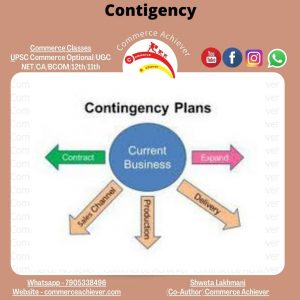
As part of a contingency plan for disasters, such as a pandemic, companies need to plan ahead to ensure that the business can operate during and after an event. This type of contingency plan is often called a business continuity plan (BCP) or a business recovery plan.
Typically, a business continuity team is formed to plan for any possible contingencies and manage the continuity and recovery plan during a disruption. Businesses need to identify their critical business functions and perform an analysis of how an event might impact the company’s operations and processes. The contingency plan would include implementing the recovery of critical business functions such as systems, production, and employee access to technology such as computers.
For example, a contingency plan for a pandemic would include developing a remote work strategy to help prevent the spread of disease and to provide employees with secure access to their work. As a result, companies would need to invest in technology, which could include providing laptops and video-conferencing access to employees, creating cloud-based data storage, and facilitating access to company-wide communications such as email and internal data.
Cybersecurity
With any type of disaster, cybercriminals often try to take advantage of a crisis to hack into a company’s systems and steal data or disrupt business operations. Contingency plans are used to outline the procedures for cybersecurity teams to protect an organization from threats and malicious attacks.
Special Considerations
A contingency plan should also prepare for the loss of intellectual property through theft or destruction. As a result, backups of critical files and computer programs, as well as key company patents, should be maintained in a secure off-site location. Contingency plans need to prepare for the possibility of operational mishaps, theft, and fraud. A company should have an emergency public relations response relating to possible events that have the ability to severely damage the company’s reputation and its ability to conduct business.
How a company is reorganized after a negative event should be included in a contingency plan. It should have procedures outlining what needs to be done to return the company to normal operations and limit any further damage from the event. For example, financial services firm Cantor Fitzgerald was able to resume operation in just two days after being crippled by the 9/11 terrorist attacks due to having a comprehensive contingency plan in place.
Benefits of a Contingency Plan
A thorough contingency plan minimizes loss and damage caused by an unforeseen negative event. For example, a brokerage company may have a backup power generator to ensure that trades can be executed in the event of a power failure, preventing possible financial loss. A contingency plan can also reduce the risk of a public relations disaster. A company that effectively communicates how negative events are to be navigated and responded to is less likely to suffer reputation damage.
A contingency plan often allows a company affected by a negative event to keep operating. For example, a company may have a provision in place for possible industrial action, such as a strike, so obligations to customers are not compromised. Companies that have a contingency plan in place may obtain better insurance rates and credit availability because they are seen to have reduced business risks.
Example of a Contingency Plan
As a result of the financial crisis of 2008 and the Great Recession, regulations were implemented requiring bank stress tests to be performed to test how a bank might handle various negative contingencies. The stress tests project how much a bank would lose–if a negative economic event occurred–to determine if the bank has enough capital or funds set aside to survive the event.
Banks are required to have a specific percentage of capital reserves on hand, depending on the total of risk weidhted assets (RWAs). These assets, which are typically loans, have various risk weightings applied to them. For example, a bank’s mortgage portfolio might receive a 50% weighting, meaning the bank–in a negative scenario–should have enough capital that’s valued at 50% of the outstanding mortgage loans. The capital–called Tier-1 capital–can include equity shares or shareholder’s equity and retained earnings, which is accumulated savings of prior years’ profits. Although there are various components that go into the tier-capital ratio requirement, the ratio has to be at least 6% of the total of risk-weighted assets.
Of course, we won’t know if the banking sector’s contingency plan will be adequate until another recession occurs, which is a limitation of these plans since it’s difficult to plan for every contingency.

You may also like


