• Home
  • Subjects
    • UPSC Commerce Optional
      • Syllabus – UPSC Commerce Optional
      • UPSC Commerce and Accountancy Optional Question Paper
      • Book
        • UPSC Commerce Optional Books – The Marathon of UPSC Commerce Optional
      • Blog
      • Courses
      • Answer Writing Practise
      • News
    • UGC NET – Commerce Optional
      • UGC NET – Syllabus
      • Past Papers
        • July 2018-Commerce
        • Dec 2017-Commerce
        • June 2017-Commerce
        • Dec 2016-Commerce
        • June 2016-Commerce
        • Dec 2015-Commerce
        • June 2015-Commerce
    • Chartered Accountant
      • Level-1 – Foundation
        • Syllabus
        • CA Level-1 Blog
      • Level-2 – Intermediate
        • Syllabus
        • CA Level-2 Blog
      • Level-3 – Final
        • Syllabus
        • CA Level-3 Blog
    • B.Com / M.Com
    • 11 Commerce
    • 12 Commerce
  • Blog
    • Income Tax
    • Economics
    • Accounts
    • Financial Management
    • HRM- Human Resource Management
    • Audit
    • Organization Behaviour
    • Industrial Relation (IR)
    • NCERT
      • 10th Class
      • 11th Class
      • 12th Class
      • 9th Class
  • Contact
    • Have any question?
    • +91 7905338496
    • achievercommerce@gmail.com
    Login
    Commerce Achiever
    • Home
    • Subjects
      • UPSC Commerce Optional
        • Syllabus – UPSC Commerce Optional
        • UPSC Commerce and Accountancy Optional Question Paper
        • Book
          • UPSC Commerce Optional Books – The Marathon of UPSC Commerce Optional
        • Blog
        • Courses
        • Answer Writing Practise
        • News
      • UGC NET – Commerce Optional
        • UGC NET – Syllabus
        • Past Papers
          • July 2018-Commerce
          • Dec 2017-Commerce
          • June 2017-Commerce
          • Dec 2016-Commerce
          • June 2016-Commerce
          • Dec 2015-Commerce
          • June 2015-Commerce
      • Chartered Accountant
        • Level-1 – Foundation
          • Syllabus
          • CA Level-1 Blog
        • Level-2 – Intermediate
          • Syllabus
          • CA Level-2 Blog
        • Level-3 – Final
          • Syllabus
          • CA Level-3 Blog
      • B.Com / M.Com
      • 11 Commerce
      • 12 Commerce
    • Blog
      • Income Tax
      • Economics
      • Accounts
      • Financial Management
      • HRM- Human Resource Management
      • Audit
      • Organization Behaviour
      • Industrial Relation (IR)
      • NCERT
        • 10th Class
        • 11th Class
        • 12th Class
        • 9th Class
    • Contact

      Accounts

      • Home
      • Blog
      • Learn - Free
      • Blogs
      • Accounts

      Contigent Assets-Meaning,Examples (Commerce Achiever)

      • Posted by commerce achiever1
      • Categories Accounts, Blogs, Learn - Free
      • Date March 24, 2021

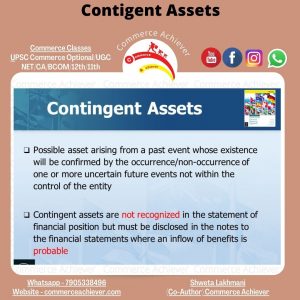
      A contingent asset is a potential economic benefit that is dependent on future events out of a company’s control. Not knowing for certain whether these gains will materialize, or being able to determine their precise economic value, means these assets cannot be recorded on the balance sheet. However, they can be reported in the accompanying notes of financial statements, provided that certain conditions are met. A contingent asset is also known as a potential asset.
      How Contingent Assets Work

      A contingent asset becomes a realized asset recordable on the balance sheet when the realization of Cash flows associated with it becomes relatively certain. In this case, the asset is recognized in the period when the change in status occurs.

      Contingent assets may arise due to the economic value being unknown. Alternatively, they might occur due to uncertainty relating to the outcome of an event in which an asset may be created. A contingent asset appears because of previous events, but the entirety of all asset information will not be collected until future events happen.

      There also exists contingent or Potential liabilities. Unlike contingent assets, they refer to a potential loss that may be incurred, depending on how a certain future event unfolds.

      KEY POINTS

      • A contingent asset is a potential economic benefit that is dependent on future events out of a company’s control.
      • Upon meeting certain conditions, contingent assets are reported in the accompanying notes of financial statements.
      • They are recorded on the balance sheet only when the realization of cash flows associated with it becomes relatively certain.

      Examples of Contingent Assets

      A company involved in a lawsuit with the expectation to receive compensation has a contingent asset because the outcome of the case is not yet known and the dollar amount is yet to be determined.

      Let’s say Company ABC has filed a lawsuit against Company XYZ for infringing a patent. If there is a decent chance that Company ABC will win the case, it has a contingent asset. This potential asset will generally be disclosed in its financial statement, but not recorded as an asset until the lawsuit is settled.

      Based on this same example, Company XYZ would need to disclose a potential contingent liability in its notes and then later record it in its accounts, should it lose the lawsuit and be ordered to pay damages.

      Contingent assets also crop up when companies expect to receive money through the use of a warranty. Other examples include benefits to be received from an estate or other court settlement. Anticipated mergers and acqusitions are to be disclosed in the financial statements.

      Reporting Requirements

      Generally Accepted Accounting Principles (GAAP) requires a note disclosure in financial statements for any contingent assets. In contrast, under International Financial Reporting Standards (IFRS), a company does not necessarily need to report contingent assets because they may never materialize. 

      International Accounting Standard 37 (IAS 37), applicable to IFRS, states the following: “Contingent assets are not recognized, but they are disclosed when it is more likely than not that an inflow of benefits will occur. However, when the inflow of benefits is virtually certain an asset is recognized in the statement of financial position because that asset is no longer considered to be contingent.”

      Contingent asset accounting policies for GAAP are outlined in the Financial Accounting Standard Boards (FASB) Financial Accounting Standard Number.

      Special Considerations

      Companies must reevaluate the potential asset continually. When a contingent asset becomes likely, firms must report it in financial statements by estimating the income to be collected. The estimate is generated using a range of possible outcomes, the associated risks, and experience with similar potential contingent assets.

      Contingent assets are ruled under the conservatism principle, which is an accounting practice that states that uncertain events and outcomes should be reported in a manner that results in the lowest potential Profit. In this case, the benefits of the asset are deferred to ensure that the financial statements are not misleading.

      Tag:CAfoundation, CAfoundationaAccounts, CAfoundationClasses, CAfoundationEconomic, CAfoundationFees, CAfoundationLaw, CAfoundationRegistration, commerce, commerceachiever, CommerceAndAccountancy, CommerceBaba, Contigent Assets

      • Share:
      commerce achiever1

      Previous post

      Contigency-Meaning,Types of Contigency plans-Protecting Assets,Investment Positions,Business Continuity and Recovery,Cybersecurity (Commerce Achiever)
      March 24, 2021

      Next post

      Contigent liabilities-Meaning,Types,Examples (Commerce Achiever)
      March 24, 2021

      You may also like

      functions & uses of Cost Accountant
      A medium size firm is making large profits and they do not have a Cost Accounting Department. There is a proposal to employ a Cost Accountant. What would you consider to be his functions and how can he make himself useful to the management
      June 16, 2023
      _Blog Post
      What are the functions of Cost Accounting?
      June 16, 2023
      UPSC Commerce and Accountancy Optional
      Commerce and Accountancy Optional Success Rate – UPSC Commerce & Accountancy Optional
      May 25, 2023
      • +91 7905338496
      • achievercommerce@gmail.com

      Our Subjects

      • UPSC Commerce Optional
      • UGC NET – Commerce Optional
      • Chartered Accountant
      • B.Com / M.Com
      • 11 Commerce
      • 12 Commerce

      Useful Links

      • Learn – Free
      • Income Tax
      • Economics
      • Accounts
      • Financial Management
      • HRM- Human Resource Management
      • Audit
      • Organization Behaviour
      • Industrial Relation (IR)
      • NCERT

      Subscribe

      Don’t lose out on any important Post and Update. Learn everyday with Experts!!

      Copyright © 2024-2025 Commerce Achiever | All Rights Reserved

      toto slot
      situs toto
      situs toto
      situs toto
      situs toto login
      toto slot
      toto slot
      idn slot
      slot hoki

      • Privacy
      • Terms
      • Sitemap
      • Purchase
      situs toto situs toto cerutu4d cerutu4d cerutu4d cerutu4d bo toto pulsa bo togel bo togel bo togel bo togel cerutu4d bandar toto macau bo toto situs togel situs togel cerutu4d cerutu4d cerutu4d cabe4d situs toto slot gacor situs togel situs toto agen toto situs togel situs toto situs togel resmi slot gacor slot gacor slot gacor
      situs toto situs toto cerutu4d cerutu4d cerutu4d cerutu4d bo toto pulsa bo togel bo togel bo togel bo togel cerutu4d bandar toto macau bo toto situs togel situs togel cerutu4d cerutu4d cerutu4d

      Login with your site account

      Lost your password?

      Message Us