• Home
  • Subjects
    • UPSC Commerce Optional
      • Syllabus – UPSC Commerce Optional
      • UPSC Commerce and Accountancy Optional Question Paper
      • Book
        • UPSC Commerce Optional Books – The Marathon of UPSC Commerce Optional
      • Blog
      • Courses
      • Answer Writing Practise
      • News
    • UGC NET – Commerce Optional
      • UGC NET – Syllabus
      • Past Papers
        • July 2018-Commerce
        • Dec 2017-Commerce
        • June 2017-Commerce
        • Dec 2016-Commerce
        • June 2016-Commerce
        • Dec 2015-Commerce
        • June 2015-Commerce
    • Chartered Accountant
      • Level-1 – Foundation
        • Syllabus
        • CA Level-1 Blog
      • Level-2 – Intermediate
        • Syllabus
        • CA Level-2 Blog
      • Level-3 – Final
        • Syllabus
        • CA Level-3 Blog
    • B.Com / M.Com
    • 11 Commerce
    • 12 Commerce
  • Blog
    • Income Tax
    • Economics
    • Accounts
    • Financial Management
    • HRM- Human Resource Management
    • Audit
    • Organization Behaviour
    • Industrial Relation (IR)
    • NCERT
      • 10th Class
      • 11th Class
      • 12th Class
      • 9th Class
  • Contact
    • Have any question?
    • +91 7905338496
    • achievercommerce@gmail.com
    Login
    Commerce Achiever
    • Home
    • Subjects
      • UPSC Commerce Optional
        • Syllabus – UPSC Commerce Optional
        • UPSC Commerce and Accountancy Optional Question Paper
        • Book
          • UPSC Commerce Optional Books – The Marathon of UPSC Commerce Optional
        • Blog
        • Courses
        • Answer Writing Practise
        • News
      • UGC NET – Commerce Optional
        • UGC NET – Syllabus
        • Past Papers
          • July 2018-Commerce
          • Dec 2017-Commerce
          • June 2017-Commerce
          • Dec 2016-Commerce
          • June 2016-Commerce
          • Dec 2015-Commerce
          • June 2015-Commerce
      • Chartered Accountant
        • Level-1 – Foundation
          • Syllabus
          • CA Level-1 Blog
        • Level-2 – Intermediate
          • Syllabus
          • CA Level-2 Blog
        • Level-3 – Final
          • Syllabus
          • CA Level-3 Blog
      • B.Com / M.Com
      • 11 Commerce
      • 12 Commerce
    • Blog
      • Income Tax
      • Economics
      • Accounts
      • Financial Management
      • HRM- Human Resource Management
      • Audit
      • Organization Behaviour
      • Industrial Relation (IR)
      • NCERT
        • 10th Class
        • 11th Class
        • 12th Class
        • 9th Class
    • Contact

      Accounts

      • Home
      • Blog
      • Learn - Free
      • Blogs
      • Accounts

      Current liabilities-Meaning,Eample,calculation,Features,Accounting for Current Liabilities (Commerce Achiever)

      • Posted by commerce achiever1
      • Categories Accounts, Blogs, Learn - Free
      • Date March 27, 2021

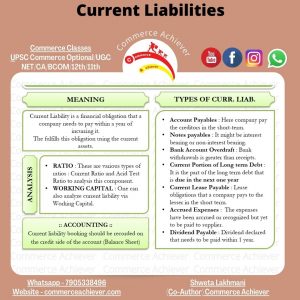
      Current liabilities are a company’s short-term financial obligations that are due within one year or within a normal operating cycle. An operating cycle, also referred to as the cash conversion cycle, is the time it takes a company to purchase inventory and convert it to cash from sales. An example of a current liability is money owed to suppliers in the form of account payable.
      Understanding Current Liabilities

      Current liabilities are typically settled using current assets, which are assets that are used up within one year. Current assets include cash or accounts receivables, which is money owed by customers for sales. The ratio of current assets to current liabilities is an important one in determining a company’s ongoing ability to pay its debts as they are due.

      Accounts payable is typically one of the largest current liability accounts on a company’s financial statements, and it represents unpaid supplier invoices. Companies try to match payment dates so that their accounts receivables are collected before the accounts payables are due to suppliers.

      For example, a company might have 60-day terms for money owed to their supplier, which results in requiring their customers to pay within a 30-day term. Current liabilities can also be settled by creating a new current liability, such as a new short-term debt obligation.

      KEY POINTS
      • Current liabilities are a company’s short-term financial obligations that are due within one year or within a normal operating cycle.
      • Current liabilities are typically settled using current assets, which are assets that are used up within one year.
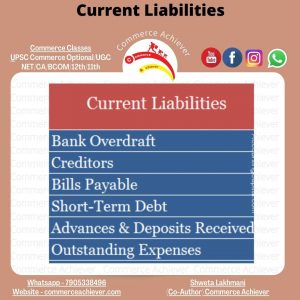
      • Examples of current liabilities include accounts payable, short-term debt, dividends, and notes payable as well as income taxes owed.

      Examples of Current Liabilities

      Below is a list of the most common current liabilities that are found on the balance sheet:

      • Accounts payable
      • short-term debt such as bank loans or commercial paper issued to fund operations
      • Dividends payable
      • Notes payable—the principal portion of outstanding debt
      • Current portion of deffered revenue, such as prepayments by customers for work not completed or earned yet
      • current maturities of long term debt
      • Interest payable on outstanding debts, including long-term obligations
      • Income taxes owed within the next year

      Sometimes, companies use an account called “other current liabilities” as a catch-all line item on their balance sheets to include all other liabilities due within a year that are not classified elsewhere. Current liability accounts can vary by industry or according to various government regulations.

      How Current Liabilities are Used

      Analysts and creditors often use the current ratio. The current ratio measures a company’s ability to pay its short-term financial debts or obligations. The ratio, which is calculated by dividing current assets by current liabilities, shows how well a company manages its balance sheet to pay off its short-term debts and payables. It shows investors and analysts whether a company has enough current assets on its balance sheet to satisfy or pay off its current debt and other payables.

      The quick ratio is the same formula as the current ratio, except it subtracts the value of total inventories beforehand. The quick ratio is a more conservative measure for liquidity since it only includes the current assets that can quickly be converted to cash to pay off current liabilities.

      A number higher than one is ideal for both the current and quick ratios since it demonstrates there are more current assets to pay current short-term debts. However, if the number is too high, it could mean the company is not leveraging its assets as well as it otherwise could be.

       Although the current and quick ratios show how well a company converts its current assets to pay current liabilities, it’s critical to compare the ratios to companies within the same industry.

      The analysis of current liabilities is important to investors and creditors. Banks, for example, want to know before extending credit whether a company is collecting—or getting paid—for its accounts receivables in a timely manner. On the other hand, on-time payment of the company’s payables is important as well. Both the current and quick ratios help with the analysis of a company’s financial solvency and management of its current liabilities.

      Accounting for Current Liabilities

      When a company determines it received an economic benefit that must be paid within a year, it must immediately record a credit entry for a current liability. Depending on the nature of the received benefit, the company’s accountants classify it as either an asset or expense, which will receive the debit entry.

      Tag:Accounting for Current Liabilities, CAfoundation, CAfoundationaAccounts, CAfoundationClasses, CAfoundationEconomic, CAfoundationFees, CAfoundationLaw, CAfoundationRegistration, commerce, commerceachiever, CommerceAndAccountancy, CommerceBaba, Current Liabilities

      • Share:
      commerce achiever1

      Previous post

      Current Assets-Meaning,Key Components of Current Assets,Formula,Financial Ratios Using Current Assets or Their Components (Commerce Achiever)
      March 27, 2021

      Next post

      Deferral-Meaning,Deferral charges,Deferral Expenses,Deferral Revenue
      March 27, 2021

      You may also like

      functions & uses of Cost Accountant
      A medium size firm is making large profits and they do not have a Cost Accounting Department. There is a proposal to employ a Cost Accountant. What would you consider to be his functions and how can he make himself useful to the management
      June 16, 2023
      _Blog Post
      What are the functions of Cost Accounting?
      June 16, 2023
      UPSC Commerce and Accountancy Optional
      Commerce and Accountancy Optional Success Rate – UPSC Commerce & Accountancy Optional
      May 25, 2023
      • +91 7905338496
      • achievercommerce@gmail.com

      Our Subjects

      • UPSC Commerce Optional
      • UGC NET – Commerce Optional
      • Chartered Accountant
      • B.Com / M.Com
      • 11 Commerce
      • 12 Commerce

      Useful Links

      • Learn – Free
      • Income Tax
      • Economics
      • Accounts
      • Financial Management
      • HRM- Human Resource Management
      • Audit
      • Organization Behaviour
      • Industrial Relation (IR)
      • NCERT

      Subscribe

      Don’t lose out on any important Post and Update. Learn everyday with Experts!!

      Copyright © 2024-2025 Commerce Achiever | All Rights Reserved

      toto slot
      situs toto
      situs toto
      situs toto
      situs toto login
      toto slot
      toto slot
      idn slot
      slot hoki

      • Privacy
      • Terms
      • Sitemap
      • Purchase
      situs toto situs toto cerutu4d cerutu4d cerutu4d cerutu4d bo toto pulsa bo togel bo togel bo togel bo togel cerutu4d bandar toto macau bo toto situs togel situs togel cerutu4d cerutu4d cerutu4d cabe4d situs toto slot gacor situs togel situs toto agen toto situs togel situs toto situs togel resmi slot gacor slot gacor slot gacor
      situs toto situs toto cerutu4d cerutu4d cerutu4d cerutu4d bo toto pulsa bo togel bo togel bo togel bo togel cerutu4d bandar toto macau bo toto situs togel situs togel cerutu4d cerutu4d cerutu4d

      Login with your site account

      Lost your password?

      Message Us