• Home
  • Subjects
    • UPSC Commerce Optional
      • Syllabus – UPSC Commerce Optional
      • UPSC Commerce and Accountancy Optional Question Paper
      • Book
        • UPSC Commerce Optional Books – The Marathon of UPSC Commerce Optional
      • Blog
      • Courses
      • Answer Writing Practise
      • News
    • UGC NET – Commerce Optional
      • UGC NET – Syllabus
      • Past Papers
        • July 2018-Commerce
        • Dec 2017-Commerce
        • June 2017-Commerce
        • Dec 2016-Commerce
        • June 2016-Commerce
        • Dec 2015-Commerce
        • June 2015-Commerce
    • Chartered Accountant
      • Level-1 – Foundation
        • Syllabus
        • CA Level-1 Blog
      • Level-2 – Intermediate
        • Syllabus
        • CA Level-2 Blog
      • Level-3 – Final
        • Syllabus
        • CA Level-3 Blog
    • B.Com / M.Com
    • 11 Commerce
    • 12 Commerce
  • Blog
    • Income Tax
    • Economics
    • Accounts
    • Financial Management
    • HRM- Human Resource Management
    • Audit
    • Organization Behaviour
    • Industrial Relation (IR)
    • NCERT
      • 10th Class
      • 11th Class
      • 12th Class
      • 9th Class
  • Contact
    • Have any question?
    • +91 7905338496
    • achievercommerce@gmail.com
    Login
    Commerce Achiever
    • Home
    • Subjects
      • UPSC Commerce Optional
        • Syllabus – UPSC Commerce Optional
        • UPSC Commerce and Accountancy Optional Question Paper
        • Book
          • UPSC Commerce Optional Books – The Marathon of UPSC Commerce Optional
        • Blog
        • Courses
        • Answer Writing Practise
        • News
      • UGC NET – Commerce Optional
        • UGC NET – Syllabus
        • Past Papers
          • July 2018-Commerce
          • Dec 2017-Commerce
          • June 2017-Commerce
          • Dec 2016-Commerce
          • June 2016-Commerce
          • Dec 2015-Commerce
          • June 2015-Commerce
      • Chartered Accountant
        • Level-1 – Foundation
          • Syllabus
          • CA Level-1 Blog
        • Level-2 – Intermediate
          • Syllabus
          • CA Level-2 Blog
        • Level-3 – Final
          • Syllabus
          • CA Level-3 Blog
      • B.Com / M.Com
      • 11 Commerce
      • 12 Commerce
    • Blog
      • Income Tax
      • Economics
      • Accounts
      • Financial Management
      • HRM- Human Resource Management
      • Audit
      • Organization Behaviour
      • Industrial Relation (IR)
      • NCERT
        • 10th Class
        • 11th Class
        • 12th Class
        • 9th Class
    • Contact

      Accounts

      • Home
      • Blog
      • Learn - Free
      • Blogs
      • Accounts

      Depreciation, Depletion, and Amortization (Commerce Achiever)

      • Posted by commerce achiever1
      • Categories Accounts, Blogs, Learn - Free
      • Date March 10, 2021

      Depreciation, depletion, and amortization (DD&A) is an accounting techniques that enables companies to gradually expense various different resources of economic value over time in order to match costs to revenues.

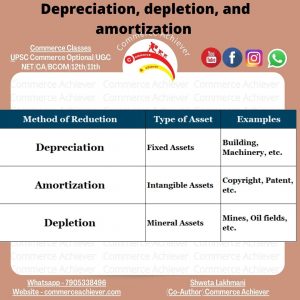
      Depreciation spreads out the cost of a tangible assets over its useful life, depletion allocates the cost of extracting natural resources, such as timber, minerals, and oil from the earth, and amortization is the deduction of intangible assets over a specified time period; typically the life of an asset.

      Depreciation and Amortization are common to almost every industry, while depletion is usually used only by energy and natural-resource firms. The use of all three, therefore, is often associated with the acquisition, exploration, and development of new oil and natural gas reserves.

      KEY POINTS

      • Depreciation, depletion, and amortization (DD&A) are accounting techniques that enable companies to gradually expense resources of economic value.
      • Depreciation relates to the cost of a tangible asset, depletion to the cost of extracting natural resources, and amortization to the deduction of an intangible asset.
      • The use of all three expensing strategies is typically associated with the acquisition, exploration, and development of new oil and natural gas reserves.
      • DD&A charges can be found on a company’s net income statement.

      Understanding Depreciation, Depletion, and Amortization (DD&A)

      Accrual accounting permits companies to recognize capital expenses in periods that reflect the use of the related capital asset. In other words, it lets firms match expenses to the revenues they helped produce.

      For example, if a large piece of machinery or property requires a large cash outlay, it can be expensed over its usable life, rather than in the individual period during which the cash outlay occurred. This accounting technique is designed to provide a more accurate depiction of the profitability of the business.

      DD&A is a common operating expense item for energy companies. Analysts and investors in the energy sector should be aware of this expense and how it relates to cash flow and capital expenditure.

      Depreciation

      Depreciation applies to expenses incurred for the purchase of assets with useful lives greater than one year. A percentage of the purchase price is deducted over the course of the asset’s useful life. 

      Depletion

      Depletion also lowers the cost value of an asset incrementally through scheduled charges to income. Where it differs is that it refers to the gradual exhaustion of natural resource reserves, as opposed to the wearing out of depreciable assets or the aging life of intangibles.

      Depletion expense is commonly used by miners, loggers, oil and gas drillers, and other companies engaged in natural resource extraction. Enterprises with an economic interest in mineral property or standing timber may recognize depletion expenses against those assets as they are used. Depletion can be calculated on a cost or percentage basis, and businesses generally must use whichever provides the larger deduction for tax purposes.

      Amortization

      Amortization is very similar to depreciation, in theory, but applies to intangiable assets such as patents, trademarks, and licenses, rather than physical property and equipment. Capital leases are also amortized.

      Recording Depreciation, Depletion, and Amortization (DD&A)

      If a company uses all three of the above expensing methods, they will be recorded in its financial statement as depreciation, depletion, and amortization (DD&A). A single line providing the dollar amount of charges for the accounting period appears on the income statement.

      Explanations may also be supplied in the footnotes, particularly if there is a large swing in the depreciation, depletion, and amortization (DD&A) charge from one period to the next.

      An entry is made on the balance sheet, too. The dollar amount represents the cumulative total amount of depreciation, depletion, and amortization (DD&A) from the time the assets were acquired. Assets deteriorate in value over time and this is reflected in the balance sheet. 

      Tag:Amortization, CAfoundation, CAfoundationaAccounts, CAfoundationClasses, CAfoundationEconomic, CAfoundationFees, CAfoundationLaw, CAfoundationRegistration, commerce, commerceachiever, CommerceAndAccountancy, CommerceBaba, Depletion, Depreciation

      • Share:
      commerce achiever1

      Previous post

      Annual Report-Special Considerations,Importance,Mutual funds Annual report (Commerce Achiever)
      March 10, 2021

      Next post

      Appropriation account (Commerce Achiever)
      March 11, 2021

      You may also like

      functions & uses of Cost Accountant
      A medium size firm is making large profits and they do not have a Cost Accounting Department. There is a proposal to employ a Cost Accountant. What would you consider to be his functions and how can he make himself useful to the management
      June 16, 2023
      _Blog Post
      What are the functions of Cost Accounting?
      June 16, 2023
      UPSC Commerce and Accountancy Optional
      Commerce and Accountancy Optional Success Rate – UPSC Commerce & Accountancy Optional
      May 25, 2023
      • +91 7905338496
      • achievercommerce@gmail.com

      Our Subjects

      • UPSC Commerce Optional
      • UGC NET – Commerce Optional
      • Chartered Accountant
      • B.Com / M.Com
      • 11 Commerce
      • 12 Commerce

      Useful Links

      • Learn – Free
      • Income Tax
      • Economics
      • Accounts
      • Financial Management
      • HRM- Human Resource Management
      • Audit
      • Organization Behaviour
      • Industrial Relation (IR)
      • NCERT

      Subscribe

      Don’t lose out on any important Post and Update. Learn everyday with Experts!!

      Copyright © 2024-2025 Commerce Achiever | All Rights Reserved

      toto slot
      situs toto
      situs toto
      situs toto
      situs toto login
      toto slot
      toto slot
      idn slot
      slot hoki

      • Privacy
      • Terms
      • Sitemap
      • Purchase
      situs toto situs toto cerutu4d cerutu4d cerutu4d cerutu4d bo toto pulsa bo togel bo togel bo togel bo togel cerutu4d bandar toto macau bo toto situs togel situs togel cerutu4d cerutu4d cerutu4d cabe4d situs toto slot gacor situs togel situs toto agen toto situs togel situs toto situs togel resmi slot gacor slot gacor slot gacor
      situs toto situs toto cerutu4d cerutu4d cerutu4d cerutu4d bo toto pulsa bo togel bo togel bo togel bo togel cerutu4d bandar toto macau bo toto situs togel situs togel cerutu4d cerutu4d cerutu4d

      Login with your site account

      Lost your password?

      Message Us