

Annual Report-Special Considerations,Importance,Mutual funds Annual report (Commerce Achiever)
An annual report is a document that public corporations must provide annually to shareholders that describes their operations and financial conditions. The front part of the report often contains an impressive combination of graphics, photos, and an accompanying narrative, all of which chronicle the company’s activities over the past year and may also make forecasts about the future of the company. The back part of the report contains detailed financial and operational information.
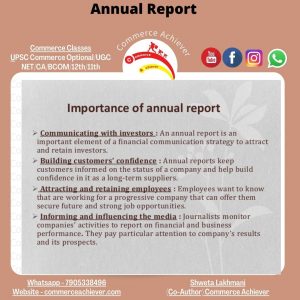
KEY POINTS
- An annual report is a corporate document disseminated to shareholder that spells out the company’s financial condition and operations over the previous year.
- It was not until legislation was enacted after the stock market crash of 1929 that the annual report became a regular component of corporate financial reporting.
- Registered mutual funds must also distribute a full annual report to its shareholders each year.
Understanding Annual Reports
Annual reports became a regulatory requirement for public companies following the stock market crash of 1929, when lawmakers mandated standardized corporate financial reporting. The intent of the required annual report is to provide public disclosure of a company’s operating and financial activities over the past year. The report is typically issued to shareholders and other stakeholders who use it to evaluate the firm’s financial performance and to make investment decisions.
- General corporate information
- Operating and financial highlights
- Letter to the shareholders from the CEO
- Narrative text, graphics, and photos
- Management’s discussions and analysis (MD&A)
- Financial statements, including the balance sheet, income statement, and cash flow statement
- Notes to the financial statements
- Auditor’s report
- Summary of financial data
- Accounting policies
Special Considerations
The annual report contains key information on a company’s financial position that can be used to measure:
- A company’s ability to pay its debts as they come due
- Whether a company made a profit or loss in its previous fiscal year
- A company’s growth over a number of years
- How much earnings is retained by a company to grow its operations
- The proportion of operational expenses to revenue generated.
The annual report also determines whether the information conforms to the generally accepted accounting principles (GAAP). This confirmation will be highlighted as an “unqualified opinion” in the auditor’s report section.
Fundamental analysts also attempt to understand a company’s future direction by analyzing the details provided in its annual report.
Mutual Fund Annual Reports
In the case of mutual funds, the annual report is a required document that is made available to a fund’s shareholders on a fiscal year basis. It discloses certain aspects of a mutual fund’s operations and financial condition.2 In contrast to corporate annual reports, mutual fund annual reports are best described as “plain vanilla” in terms of their presentation.3
A mutual fund annual report, along with a fund’s prospectus and statement of additional information, is a source of multi-year fund data and performance, which is made available to fund shareholders as well as to prospective fund investors. Unfortunately, most of the information is quantitative rather than qualitative, which addresses the mandatory accounting disclosures required of mutual funds.

You may also like


