
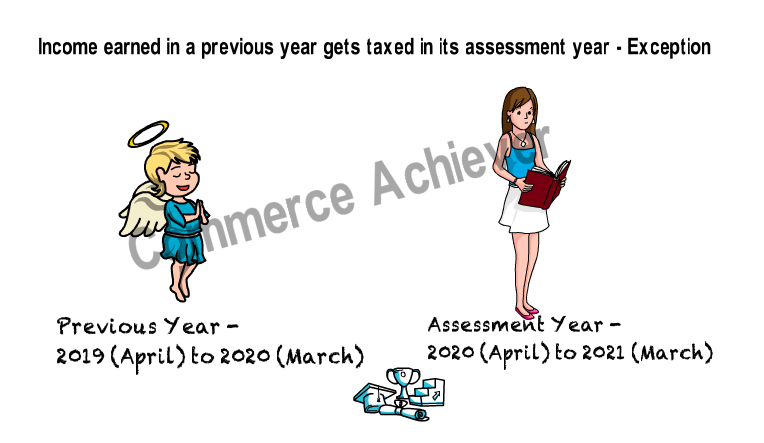
Income earned in a previous year gets taxed in its assessment year – Exception (Income Tax)
Normally, income earned in a previous year gets taxed in its assessment year.
However, in certain cases, where income is not disclosed by the taxpayer but is detected by the Income Tax department and the source for which is not satisfactorily explained by the assessee to the Assessing Officer, it is deemed to be the income of the year in which it is so detected.
Following are such cases –
(i) Cash Credits [Section 68]
Where any sum is found credited in the books of the assessee and the assessee offers no explanation about nature and source or the explanation offered is not satisfactory in the opinion of the Assessing Officer, the sum so credited may be charged as income of the assessee of that previous year.
(ii) Unexplained Investments [Section 69]
Where in the financial year immediately preceding the assessment year, the assessee has made investments which are not recorded in the books of account and the assessee offers no explanation about the nature and the source of investments or the explanation offered is not satisfactory in the opinion of the Assessing Officer, the value of the investments are taxed as deemed income of the assessee of such financial year.
(iii) Unexplained money etc. [Section 69A]
Where in any financial year the assessee is found to be the owner of any money, bullion, jewelry or other valuable article and the same is not recorded in the books of account and the assessee offers no explanation about the nature and source of acquisition of such money, bullion, etc. or the explanation offered is not satisfactory in the opinion of the Assessing Officer, the money and the value of bullion, etc. may be deemed to be the income of the assessee for such financial year.
(iv) Amount of investments etc., not fully disclosed in the books of the account [Section 69B]
Where in any financial year the assessee has made investments or is found to be the owner of any bullion, jewelry or other valuable article and the Assessing Officer finds that the amount spent on making such investments or in acquiring such articles exceeds the amount recorded in the books of account maintained by the assessee and he offers no explanation for the difference or the explanation offered is unsatisfactory in the opinion of the Assessing Officer, such excess may be deemed to be the income of the assessee for such financial year.
(v) Unexplained expenditure [Section 69C]
Where in any financial year an assessee has incurred any expenditure and he offers no explanation about the source of such expenditure or the explanation is unsatisfactory in the opinion of the Assessing Officer, Assessing Officer can treat such unexplained expenditure as the income of the assessee for such financial year. Such unexplained expenditure which is deemed to be the income of the assessee shall not be allowed as deduction under any head of income.
(vi) Amount borrowed or repaid on hundi [Section 69D]
Where any amount is borrowed on a hundi or any amount due thereon is repaid other than through an account payee cheque drawn on a bank, the amount so borrowed or repaid shall be deemed to be the income of the person borrowing or repaying for the previous year in which the amount was borrowed or repaid, as the case may be.
However, where any amount borrowed on a hundi has been deemed to be the income of any person, he will not be again liable to be assessed in respect of such amount on repayment of such amount. The amount repaid shall include interest paid on the amount borrowed.
Note- Section 115BBE provides the rate at which such cash credits, undisclosed income, undisclosed expenditure, etc. deemed as income under section 68 or section 69 or section 69A or section 69B or section 69C or section 69D would be subject to tax.
For Numerical – Refer to Youtube Channel.
For Complete Course or Book (Videos on provisions, Numericals, Tests, Guidance, etc) –
CONTACT US-
Tag:11 commerce, 11th commerce, 12 commerce, 12th commerce, ASSESSMENT YEAR, Barnard-Simon Theory, Barnard-Simon Theory of Organizational Equilibrium, bba, bcom, ca, ca cpt, ca final, ca inter, commerce, commerce achiever, commerce optional, cs, cs final, cs inter, direct tax, Income earned in a previous year gets taxed in its assessment year - Exception, income tax, mba, mcom, Organization Equilibrium, PREVIOUS YEAR, PREVIOUS YEAR AND ASSESSMENT YEAR, tax, Theory of Organizational Equilibrium, ugc net, ugc net commerce, ugc net commerce optional, upsc commerce optional, upsc commerce optional paper, upsc commerce optional previous year paper, upsc commerce optional syllabus, upsc optional


